
Author: Deniz Seyrek

BATUMI – TBILISI – TELAVİ

After following a route for 2 months in Turkey, from a far west island at the agean sea, to Bursa, Tunceli, Artvin and Rize, I came to the northeast end of Anatolia and bumped into the border of Georgia. It was time to discover Georgia now.

Georgia is a quite small country with a population around 4 million. In this essay I’ll be telling about the south part of the country, Batumi, Tbilisi, Telavi. You will find about the mountainous north parts around Mestia in the other essay.
There are 2 Russian occupied territories; Abkhazia and South Ossetia (marked in red above). If you are interested in mountaineering and trekking, you need to watch out your steps to not to enter into these territorities.

Mountains and forests were already with me for some time. It was now time to let myself fully to the Caucasus, to the lands of spectacular mountains, forests, rivers and national parks. At first I was not knowing, nevertheless sensing what is there to come from this piece of heaven.
Gamarjoba! (hello in Georgian)

My first stop was at Batumi, the third biggest city of the country, located on the coast of Black Sea. Especially for nature lovers, it has a very impressive and enormous Botanical Garden that started to be created over 100 years ago.

Batumi Botanical Garden has many zones; South America, New Zealand, Australia, Himalayas, Mexico, Europe and so on. In the whole area, there are many different types of roses, bamboos, fruit forests, flowers, exotic plants as well as monumental old trees like above.

Batumi’s economy revolves around tourism and it is an important port at Black Sea. Arriving at a new place, I like to have a look at the whole area from above. My friends took me to a pretty church on top of a hill. Modern high-rise buildings, mostly hotels were filling the shores. But on the hills, tiny houses were rarely spreaded between the dense green.
Batumi hosts ‘Man and Woman’, 8m tall moving steel sculpture which is a work of Georgian artist Tamara Kvesitadze. These two metal figures pass through eachother on a daily basis, telling their story of love and seperation. I love it!

Church Sameba is located on top of a high hill and have a great view of the city.
The priestess refused to give me candle to light since I’m not a Christian. But this wasn’t an obstacle for my silent and peaceful meditation accompanied by the senses of blessings and greetings to this new country I’ve just arrived.

Historical old town of Batumi hosts many 19th century buildings. Around big squares, there are nice little roads full of many restaurants, wine houses, bars. Seaside is just couple of blocks away.

This lovely young girl Mari and her brother Levan hosted me in Batumi. I have to mention the great hospitality Georgians have for their guests. They helped me in my every need open heartedly and generously. Georgians don’t ask if you’re hungry, they just set the table! Staying, spending time in their little, humble neighbourhood showed me many things about the daily life around here.
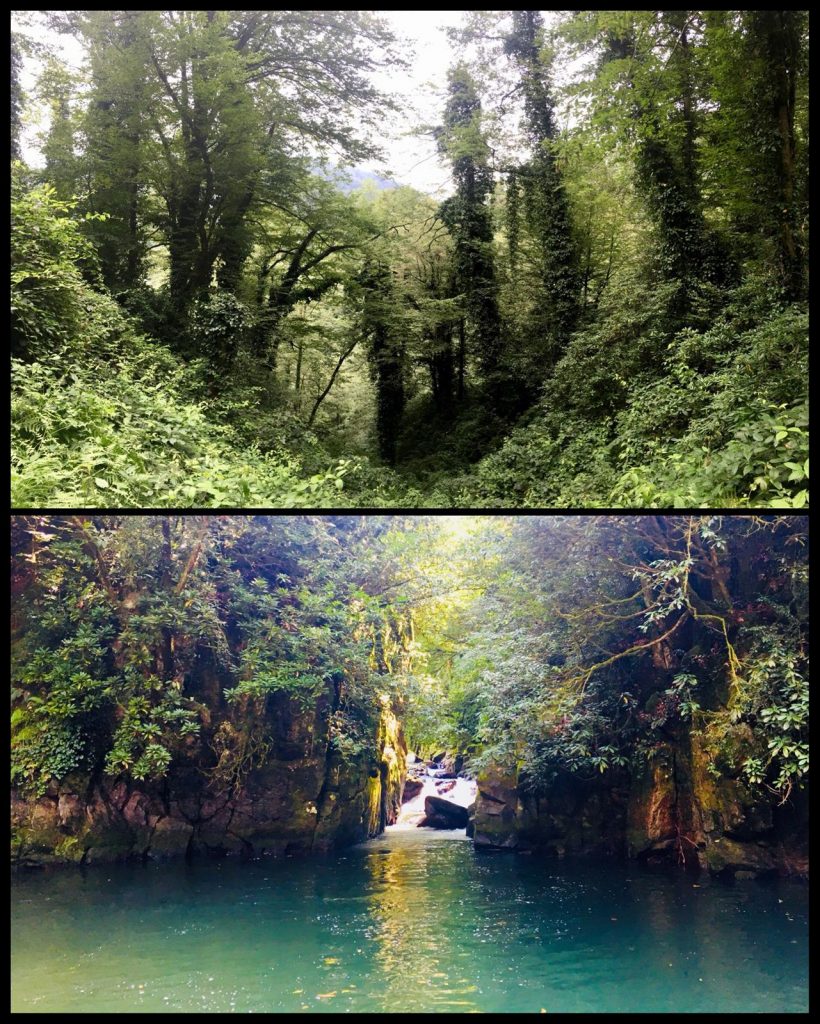
Mtirala National Park (above) deserves a day visit. It’s just an hour drive from Batumi. You can spend your day walking into the dense forests that eventually takes you to a small lake and a fantastic waterfall.

Mtirala National Park is one of the most humid areas of the country. It has mixed forests including mostly chestnut, beech trees and rhododendrons.

It was so peaceful to explore the park in its broadness as well as in its details. It was the first time this year that I saw a rhododendron flower. I love them.

There are many beekeepers in this area. Old man with his grandchild above were selling many kinds of honey at their stall. When Georgians learn that you are from Turkey, you usually see a smile on the faces right away. They become more interested in you somehow with the hospitality of a neighbour.

After Batumi I passed to the east, to Kakheti region through beautiful forests seen above.
Marshrutka (shared taxi or a minivan) is the most common public transport in Georgia. Sorry to say but Georgia can be one of the places that has careless, fast and worst drivers ever!

My second stop at South Georgia was Telavi, the capital of Kakheti region. Here is a huge plain at the feet of Caucasus mountains that unfortunately have been deforested for agricultural purposes for some time. Nevertheless its fertile soil feeds the vineyards. You see many ‘wine route’ signes on the roads that take you to the producers. More than half of the production of the country comes from Kakheti region. Over 500 of the world’s 2000 grape varieties are Georgian.
It feels like life runs slow in this region. I really liked to be in the country side, by the villages and discover the way of living here.

Two rainbows shining after the rain. Just by the door of my friend Mayis’s house.

It was so lovely to visit my friend Mayıs whom I know from Turkey. He and his adorable dog Haiku hosted me in their beautiful house in Kisiskhevi village near Telavi. It was a lovely coincidence that I also met my other friends Pınar and Yakup here. We updated what had come along into our lives since we last met. Having nice long conversations, having long-short walks around, going downtown for the colorful farmers market, cooking delicious food together, toasting with delicious Kakheti wine, our laughters, our silence, all were in peace. Spending times together with them really warmed my heart and gave me the chance to slow down again for some time.

One day altogether we went to the eastern part of the country, by Azerbaijan border. We did a half day trek at Lagodekhi National Park (above). The most prominent trees here were beech and maples.

At Lagodekhi National Park the valley we walked through, the waterfall and the weather was fantastic.

And then I came to my third stop at South Georgia, to the capital, Tbilisi which means the ‘Hot City’. There are many historical sulfur baths and hammams around. Mtkvari river is running through from the heart of the city. Apart from visiting some museums, wandering around in the old towns and walking the silent boulevards at nights, I dont have much to do with the cities so I’m skipping them mainly. Therefore I stayed here for just 2 days and managed to find some second hand warm clothes for the times coming in north.

Georgian people have been playing a wide variety of instruments throughout many centuries. Some of them are local and the others reached here from the countries around. Above you see Panduris which is one of the common played instrument. Georgian polyphonic singing is an old tradition that used to accompany all areas of daily life, while dining or working. It also includes some love songs. Above we see a group of men singing in the way of this old tradition.
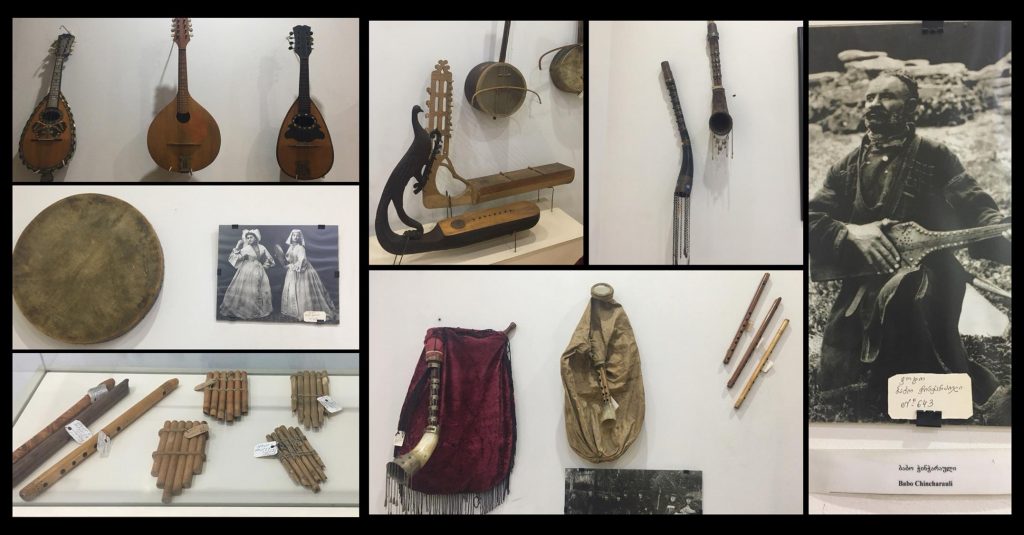
There is one place in Tblisi which is worth to visit. ‘Georgian folk songs and musical instruments’ museum. Some of the instruments I remember from my visit are;
String instruments: panduri, tar, kemence, saz, santur, ud, sitar, cengi, mandolin, gitar
Wind instruments: zurna, duduki, tulum
Percussion instruments: daira
The man on the right is one of the most important panduri player of Georgia, Babo Chincharauli.

Above we see the local taste Churchkhela that is string of nuts coated in grape, plum or pomagranate caramel.

Above we see some other local tastes like; Tashmijabi (potato with traditional Sunguli cheese) and Khachapuri (bread filled with cheese). And of course famous Georgian wine.
Georgians have been making and drinking wine for at least 8000 years. Local method of making wine is different from European style wine making and it remained unchanged through centuries. A common tradition here is to toast, mostly with wine and cha cha (so strong local drink). Tamada is the toastmaker who toasts for many different things like, good health, wealth, Georgia, ancestors, protection of children etc. Drinking before the speech gets over is impolite. And this tradition can last for hours till the sunrise!

Then the time came to move to north, to the mountainous regions of Georgia.

UPPER SVANETI

I welcome you to the highest part of Caucasus mountains. These great mountains start from Blacksea on the west, runs the length of Georgia&Russian border, continues into Azerbaijan and ends at Caspian sea on the east.
While traveling one of my greatest interest is nature and landscapes. I need to say, to be in the mountains has a special place in my explorations. Mountains -in their nature- reserve high frequencies. If you open yourself fully then unforgettable experiences unfold one after another.

Sitting in my silence, I feel the precious existence of the mountains, forests, each and every being living there. And the rivers that run relentlessly to bring life. And the moon that illuminates the darkness. And the fire that heats my every muscle and bone in cold nights. . .
These felt senses in their nature bring a limitless joy and love into the moments. Through the great interconnectedness of all beings, my heart sings. This is one of the reasons why I travel. My experiences through travelling end the longing, end the sense of seperation. I deeply feel one with everything as everything.
I am in LOVE with the mountains.

The north part of Georgia, Svaneti is a unique place. 4000m plus snow covered peaks are rising above alpine meadows. There are spectacular mountain sceneries all over the place and there are many trekking routes. It’s also a well preserved area in terms of historical heritage. You see many medieval age villages with towers.

The easiest way to go to Mestia is taking the night train (10 hours) from Tbilisi to Zugdidi, then taking the marshrutka (4 hours) to Mestia. The vehicles are full of mountaineers, trekkers from all around the world. The journey with this minibus takes you through wonderful green valleys right into the highest heart of Caucasus mountains.

Mestia is the capital of Upper Svaneti region. It is surrounded by many beautiful and high mountains.
Above right we see Banguriani mountains (3838m) and above left we see Ushba (4710m) that is rising sharply over Mestia.

Svans are the ethnic group living here through many centuries. Svan towers –also known as koshi- gift Mestia its unique look (above). They were build between 9-18th century primarily for religious purposes but then they started to be built for the protection from invasions of the clans. Since there was no higher power, every clan was responsible for its own protection. Blood feuds between the clans were well known that could last for decades. These 4 or 5 floor towers were also used in case of avalanches.

There’s a well designed etnography museum in Mestia. And also there are well preserved Svan houses (machubi) that work as little museums. Above is the interior of one of them that takes you to a voyage to medieval ages. The center of the place was used to cook, dine and live. And behind the artistic carved wooden panels, animals were kept as well as the food stocks for winter.

There is a simple life going on in the neighborhoods of Mestia. The horses, cows, pigs are wandering around freely in the roads. Especially the freedom of cows and the cow shit on the roads are reminding me of India. Above we see Laila mountains (4008m) rising on the west side of Mestia.

Georgia is a heaven for trekking. In most of the regions there are different routes in different lanscapes. Upper Svaneti – Mestia, Lower Svaneti – Racha, Kazbegi, Tusheti, Kakheti, Vashlovani are some of the destinations. Best trekking season is from June to mid-October. Some routes are well signed, some not. Some have guesthouses, some have tourist shelters. And some have just rare sheppard huts so that you need to carry your tent and food.

Caucasus mountains are at Georgia’s north border. Many beautiful trekkings start from Mestia.

I did my first trek to Shdugra (Mazeri) waterfall (above). You reach there through the beautiful remote village Becho which is in this spectacular valley in between the mountains.

The trek to the waterfall passes by the beautiful and strong river called Dolra. On our walk we came across the shelters of Georgian soldiers guarding their territory which is just a few km away from Russia.

There are times I can even hear my heart beat and I keep on walking. The more I walk the more I open up and feel charged. The energy arises and I feel stronger.

I did my second trek to the Cross and Koruldi lakes. It is a one day walk around 20km (1350m up, 1350m down). First you reach the cross at the north top of Mestia (800m) then reach Koruldi lakes at the end. During the trek at some points you walk through rising meadows with some grazing animals. Beautiful Mount Tetnuldi (4858m) –also known as the ‘white bride’- is clearly seen on one side (above, right).

Koruldi lake above reflects the image of the beautiful mountains perfectly.

Then I did my third trek which lasted for 4 days. This is one of the most popular long trek between Mestia and Ushguli.
The stages: Day 1: Mestia to Zhabeshi, Day 2: Zhabeshi to Adishi, Day 3: Adishi to İprali, Day 4: İprali to Ushguli
Each of the first 3 days takes you up on a ridge, then it is followed by a descent.

Likewise many routes in Himalayas, this route is a kind that you can find guesthouses to stay at some points. But this time I was so lucky to find companions, a group of Georgian trekkers who invited me to share their tents and camping equipments. After finishing the first day we chose this beautiful spot for our camp. And the next morning we woke up to a clean clear morning at Zabeshi (1800m).

The second day walk gifted many different perspectives, sometimes lush green forests, sometimes rocky mountains.

As we climbed to the highest point of the day we came across with these three brothers from the village below. They were so friendly and cheerful. Living their childhood in an area like this, I thought how lucky they are.

Many types of flowers in different colours are decorating the hills. Blue butterflies are dancing around. Autumn is starting to show itself in yellow, red, brown colours on the trees. You see impressive but fragile rock formations on the way.

Arriving at the beautiful little village Adishi (2100m) above. It is the end of the walk of the second day.

Starting the third day, I didn’t know that it would be one of the most impressive walks I’ve ever done in my life. During the walk at one point you have to cross a river. You need to arrive there in the morning before the water level gets high. It’s better to take it seriously as I heard about a couple who attempted to cross it in the early evening and had to struggle with the strong stream for hours until a rescue team arrived. You can cross the river with horses or else -as I did- you can cross it barefoot and trust your stable and strong steps in the powerful current. Ice cold water of the glacier gave an enourmous aliveness to my legs and feet that I climbed the next steep stage with ease.

Ta taaa! Tetnuldi and its glacier (above) It is almost a 5000m mountain, so imagine the scale. There is nothing in between me and this beauty. It’s standing just in front of me. What a strength! So alive, so real, so pure. When the deep and powerful sound of the shattering of the glacier arrives, it makes my heart beat faster.
I left Mount Ushba (4710m) behind which is one of the most beautiful as well as the most deadliest one and reached Mount Tetnuldi (4858m). Ushba is known to be the male and Tetnuldi is known to be the female mountain. It’s believed that they are in love but in a desperate love because they cannot come together.

Leaving Tetnuldi behind, in the afternoon I reached Chkhundari pass above (2730m) and saw the new valley from which I would go down through. In this new valley there are many springs popping up from many points. Some of them has mineral water.

Each night we set up the fire at our camp. In our humble meals there was always wine and cha cha (a traditional strong spirit made of grapes). Georgians -of any age- love to toast really. At one point one of the guys toasted for women, saying; without the women life wouldn’t be this much colourful. And I took the next place and toasted for men, for the precious lessons, meaning and love they bring to life.

Then I arrived at Ushguli in the end point of 4 days.
This view above was just a photograph I came across and get fascinated in internet months ago. That was exactly when I said to myself; go and live this!

I was more than happy to complete the trek and arrive at Ushguli. Crossing the mountains, leaving a valley behind and entering into the next one, I walked with the curiosity of a child. I woke up to each new day with a sincere interest. This excitement boosted the aliveness, the happiness in me.

Svan towers of Ushguli (above and below)

Ushguli -as seen in other parts of Upper Svaneti- has this unique traditional feature where towers, roofs are all made of stone. The doors are really impressive. The door on the right above has the bull head which is an icon from the pagan times of Svans.

Coming to Ushguli gifts you this magnificent view of Mount Shkhara (5193m) which is the highest mountain of Georgia (above). Its enormous size has a disorienting scale. Behind it there is Russia.
The stone building we see in front is Lamaria Monastery. It reminded me of Nepal, of Himalayas, of Buddhist monasteries there.

Sometimes my body speaks out, my heart beats so fast, my muscles burn, my head gets dizzy, I feel cold. Then I ask, who is it that feels all these? Sometimes I fear. Then I ask; who is it that is fearing? Sometimes I shed tears out of a bit of grief that I still carry from the past. Then I ask; who is it that is crying?
This is how purification manifests itself.
The gifts are overflowing. Magical sceneries of mother earth, wise whispers of the wind, a cup of soup or a warm bed. With gratitude I’m taking them. But not keeping or holding on to any of them. Then giving what has been offered; my perceptions, feelings, senses. Fully giving, offering myself to the higher Self.
This is how purification manifests itself.
Everything is merging into eachother, losing their identity as the way I knew. One consciousness is becoming visible in all phenomena. I am That.

* The ‘who’ question I mention above is a part of the practice of ‘self-inquiry’. If you are interested to know about it, you can check two of my essays in India folder; Tiruvannamalai Part I and Tiruvannamalai Part II.

This summer I am so satisfied with my experiences by the mountains, forests, rivers, waterfalls. I feel deeply grateful.

Then the time comes for me to move to a new country, Armenia.

NORTH ARMENIA

After leaving Georgia, I strayed into Armenia before my route took me to Iran. Life gifted me many experiences and spectacular visions in this ancient lands. I will remember this country with its breathtaking sceneries of nature, its deep and rich history, interesting medieval monasteries and of course again with its lovely people.

Here I am standing at the feet of Mount Ararat which is the highest mountain of Turkey. (5137m) From the lands of Armenia, I am looking at this beauty for the first time in my life, feeling how all the borders are just imaginative lines that can never seperate the sisterhood, brotherhood of humanity.

These are the opening views that I saw in my very first day in Armenia. Leaving the lush green forests behind in Georgia it was quite surprising to see the changing landscapes into desert like features now. I really like to travel this way, by not bouncing to one place -lets say by flying- and find myself at that point out of blue. I prefer to plan routes in such a sequence that I can see the changes in the landscapes, settlements and the elements of culture.

I’ve chosen Yerevan, the capital as my first base as you can visit many sites in a day trip from here. My first visit was to Garni Gorge. (above)
Due to my low budget I’ve mostly taken local buses or marshrutkas but I must say public transport is not so practical in Armenia as there aren’t many buses running all day long. Hitchhiking works fine or as another option you can use shared taxi. Remember it is not easy to make a last minute plan as people are quite laid back here.

Garni Temple situated at Garni Gorge (above) is a symbol of pre-Christian times and can be seen as a Neo-Pagan shrine. Even though there had been many invasions (Greek, Roman, Persian, Arab) or eathquakes in the past, we can still see a big list of historical sites all around the country. And luckily most of these sites are set in extremely beautiful sceneries.

Geghard Monastery complex (above) is dated from 4th to 13th century and is my favourite out of many monasteries I’ve visited in Armenia. It’s surrounded by rocky cliffs.

Geghard Monastery (above) is partly carved out of the mountain. It’s unbelievable to think how these huge spaces as well as all the details had been carved and formed out of rocks. I’m so impressed by the magnificent acoustics and the lights flowing into the space through picturesque ceilings.
My interest is not the detailed history of all monasteries but I’m more into the feeling, into the vibration of the spaces. In this sense Geghard gifted me a spectacular experience in its dark and mysterious medieval interiors.

The interiors are highly impressive. Above we see three dimensional representations of animals and geometrical patterns on the walls.

I took a day to see the surrounding of Lake Sevan in the east of Armenia. It is the largest lake in Caucasus. (80km length, 30km width) It has some historical sites and some beaches in the waterfront. Hayravank Monastery –we see on the left side above- has been enjoying the calm and peaceful scenery for the last 11 centuries here.

Sevanavank Monastery (9th century) at Sevan Lake (above)

Another historical site by Sevan Lake is Noratus Cemetery (above). It has the largest group of khackhars in Armenia. Khachkars are the steles carved from stone which are the characteristic of medieval Christian Armenian art. They act as memorial stones and focal points for worship. They were erected mostly for the salvation of the soul.

Khachkars are ornamented with crosses which rest on the symbol of sun or wheel of eternity. They also take many other forms and details -such as the ones on the right- where you see images of farmers and animals. There are more than 40.000 khachkars in Armenia.

Coming back to Yerevan, the capital. This is the Republic Square (above) at the heart of the city. The building you see on the right is the History Museum of Armenia which is a really well-designed big museum. It has wide range of archeological and ethnographic collections. It is worth to visit due to the rich and deep history of Armenia. You can also attend the very informative walking tour that starts everyday in front of this building at 17.00. If you do so, say hi from me to the guide Vako.

There are many churches and cathedrals in the city, some old, some brand new. Above is an example of a new one, Saint Gregory the Illuminator Cathedral. All Armenian religious structures have one common distinctive element which is the conical, umbrella style domes.

There are 1 million people living in Yerevan. (3 million in the whole country) It is a vibrant city full of theaters, libraries, museums, parks, squares, cafes and restaurants. Many old buildings are still standing in central neighbourhoods. Above is the view from the Cascade where Mount Ararat is again visible as in most parts of Yerevan. The sculptures and grafittis of many international artists are all over the place in the city.

There are almost 2000 street fountains called Pulpulak in Yerevan. (above) I was so pleased to see them as a traveller who is quite attentive on avoiding the consumption of plastic water bottles.

Another important site to visit close to Yerevan is Khor Virap Monastery (above) which is one of Armenia’s major pilgrimage destinations. The Monastery stands at the foot of Mount Ararat, just few kilometres away from Turkish border. Mount Ararat is a holy mountain for Armenians. According to Bible Armenians are the descendants of Hayk, great great grandson of Noah whose ark grounded on Mount Ararat after the flood.

Then I felt this was it for north Armenia and I hit the road for the southern parts.

SOUTH ARMENIA

Then it was time for me to leave northern and middle parts of Armenia and move to south. I took the bus from Yerevan to Goris. (5 hours) The one above and the couple of next photographs are showing the transition between these 2 regions. I really enjoyed the sceneries all along the way.

Mountains are really impressive in mid parts of Armenia. Little towns and villages look like green oasis in vast dry areas.

Mountains and hills line up one after another. At one point on the way you pass by Spandaryan Reservoir (above) which is the home for different kinds of birds.

Passing down to south you start to see many predators up in the sky. I am always so fascinated to watch them. You sometimes see them making huge circles in the sky and sometimes you notice them just sitting on a big rock, carefully watching the big fields. Then I found out that this region is home of many types of eagles – especially golden eagles and vultures.

The landscape here is surrounded by pastures that are home to grazing animals. I really like this photograph (above, right) which I took from the bus. I like the way the young sheppard looks through me at that very moment. The sheppards are usually using horses. Cars are sharing the roads with many herds along the way.

I’ve chosen the small and cute town Goris as my second base to see some of the southern parts of Armenia. There are cone shaped rock formations (reminding me of Cappadocia in Turkey) located in the east part of the town.
I’m always choosing one of the cheapest hostels to stay. This way I’m meeting many long term travelers like me. Here I met many trekkers, some of them Alpinists who had already climbed Mount Ararat and Mount Aragats (the highest of Armenia). Some walked pretty long hikes here around 130km and were planning to go to Nagorno Karabakh for other long distance hikes. There was a guy who cycled here all the way from Germany. We exchanged our experiences of our journeys and altogether underlined what a blessing it is to travel.

Old Khndzoresk is a cave village close to Goris which was the biggest village of east Armenia in the end of 19th century. It used to be inhabited till 1950s when the Soviet officials forced the villagers to leave.

Old Khndzoresk is famous for its canyon with ancient cave settlements. It is located on the steep slope of a gorge. And this 160m long suspension bridge is connecting two sides of the gorge.

Vorotan Gorge (above) which -known as Armenia’s grand canyon- is carved by a beautiful river. Canyon walls can reach up to 100 meters. And there are natural baths of mineral water in some parts. Hiking is excellent in this area.
Vorotan Gorge has the world’s longest cableway of 5,7km. You can see it on the picture above, on the right. I couldn’t believe my eyes when I first saw the cable cars moving on so high up in the air for kilometers without having any vertical support. It links you to Tatev Monastery in a short time. Or you can also take the road up and down the valleys for beautiful perspectives of this gorge.

At old times Harsnadzor Watchtower (above) at Vorotan gorge was the third in a chain of warnings in case of enemy attack. The bell was warning Tatev monastery and it was the biggest bell whose ring was heard across a 50km radius informing every habitant in the region.

Tatev Monastery (above) has been standing on the edge of massive cliffs of Vorotan gorge since 9th century. During medieval times it was an important spiritual center and played an important role in academic and social-political life as it hosted one of the most important Armenian medieval universities.

Main church at Tatev Monastery (above)

Many village settlements have the spectacular view of Vorotan Gorge. (above) I have also stayed here in this valley in one of the villages close to Tatev monastery.

Barev! (hello in Armenian)
The pictures above show two families who hosted me in their traditional village house. On the right above; you see the lovely couple Armine and Artak. Armine is a great cook. I’ve eaten the best food here; home baked bread, eggs, cheese, butter, honey, jam, fruits, vegetables, herbs all from the village. It is the season of some fruits like grapes, walnuts, figs and berries so Artak was mostly busy doing harvesting. Plums were laid on the floor of the terrace to dry in order to make the votka of coming winter. The next door neighbours Alla and Vazgen was around all the time, sincerely taking care of my needs and comfort. Vazgen played us piano after the dinner while we were drinking their home made wine. How joyful it was to play with 3 and 5 year old Anahit and Bagrat in the garden. Peace was everywhere.

Many things here felt so familiar with the elements of the culture I was born to in Turkey. Like the melodies in the traditional music. There is an instrument here called Duduk, a double reed instrument made from apricot wood. Oh, its deep sound somehow connects me with my roots right away whenever I hear it. Bar, traditional circle dance or the geometries in the carpets, kilims are quite the same in Anatolia. There are also many common recipes in the cuisine like dolma, lavash, jajik, sujukh, basturma, pilaf that are defined with quite the same words in Turkish.

Before passing to Iran, I took my last days to reflect on my experiences in Armenia. Shanti shanti I let myself into slow, easeful, peaceful times, writing my diary, having the sun on my shoulders, making love with this little kitten. The smell of the peach jam that Armine cooked was in the air. It was soo peaceful.

A TRIBUTE TO THE ESSENCE OF IRANIAN PEOPLE

Oh Iran, what a magical country. It is the home of many wonders, of great history and immense wisdom. Spectacular mountains, forests, deserts, coastlines shape its relatively big lands. Many ethnic groups living in different regions are still preserving their traditions and cultural heritage. Amazing architecture of mosques, palaces, bazaars, gardens are so unique. Colours, tastes, music, poetry and nature fascinate every sense here. What a unique experience it is to travel in Iran!

Above are the places I visited in 3 months during my first journey in Iran. (October-November-December 2019)
When choosing Iran as a destination, what appealed me at first was the wisdom it holds for generations in which I wanted to dive deep into. Putting this on one side, my best experience that will live in my memories is the sincerity of lovely Iranian people. To me it is the frendliest country I’ve ever visited. Warm hearted Iranian people have such a great hospitality that they always welcome you with open arms.

Traveling in Iran for 3 months gifted me many chances to experience this open hearted ground. I’ve never met this much of sincere people who –even without knowing you, just right away- open their hearts and doors and present such a hospitality and support. The more I experienced this, the more I realized how it is linked to one of the most fundamentals about Iranian culture and tradition which is Taarof.
Taarof is a highly valued behaviour and it is about how people should treat each other. Individuals seek to raise the other person’s status and lower their own. This reminds me of one of the core teachings of Buddhist tradition which gently orients the person to care of the needs of the other, rather than keeping on focusing on the needs and desires of the individual. Because by this way ego loses its dominant power which all the time tends to say; me, me, me! So the secret here is to always consider the other and put his or her needs first. This expands the so called limitations of the heart.

A guest in Iran is like a precious jewel. Hospitality is not like a task they do but you will see; they love it, they enjoy it. You will be invited countless times for a dinner or for an overnight stay even by the people you meet on the street. They put themselves out for you by sharing what they don’t have enough of. They willingly give their one bed and sleep on the floor. When you want to pay to a seller in the market or to a taxi driver, they always give this respond; returning the money back to you; “Be my guest.” When you want to enter through a door or sit on a dining table or start to eat, you hear: “Befarmaeed” which means “Please welcome” or “After you”. Lets say when you compliment on the beauty of a girl’s necklace, she right away offers it to you.
While this concept is generally positive, it can be manipulative when used improperly, when someone tries to benefit from the generosity of another. Such behaviour is seen as negative as it masks arrogance rather than expresses humility.

For Iranians, kind words are always important. Maybe it is because the Persian spirit carries a lot of poetry in it that has a language full of kindness. In a relatively short time I found myself in deep relationships, heart to heart connections with mature souls who dedicated their hearts to purity and kindness. I rested in their embrace. What a blessing! A response to my call from the universe.
Thank you all! I am honoring the virtues in you. You are great teachers!

Every country gifts me different insights. Amongst all, Iran is beyond comparison. It is glittering! Iran had been a home for me where I deeply experienced the meaning of how to love. A few years ago my deep spiritual seeking had started with this simple question: “How do I love?” Then life taught me how to free myself from my burdens and obstacles, my ego and pride and how to become naked. It was the opening of the years of maturity and is still an ongoing process. Then coming to Iran, my insights at the feet of saints and poets, my experiences with the people and culture, in the embrace of mountains, deserts, ocean guided me more and more into my realizations. The source is awakening, reminding me to trust, trust and trust. Iran had become the ground where the deep meaning of ‘Love’ revealed itself in the most meaningful way, in the purest, deepest form.
When I go to a place or a country for the first time, it was a tendency of me to wonder about what the new place will bring me, show me, gift me. But this time, travelling in this magical lands not only offered me immense range of experiences but also set the ground in which I offered back what is overflowing through me. It was like a mutual dance of giving and receiving which naturally enabled a deeper and more meaningful life. I was quite conscious whether I was assigning an illusory meaning or not. But the voice within and the beings that I interact with were all calling out that this was so true.

As I learn through being, know through being the limitless love -which is the ground of all existence- my ability and capability to love is expanding. Moments of subtle awakenings becomes visible in the form of love, joy and peace. Many people spoke of how they are drawn to the peace in my presence, how they find understanding, love and healing in my voice and talks. A dear friend told me; “I saw your dance with the day and the night, moon and the sun and the ocean. I saw how you love with admiration and devotion. You receive what you give. Many people spoke of you, think of you, wondered about you, followed you with a sincere interest and love. You awakened light onto some people’s darkness.”
You may naturally think I’m praising myself. But no. Actually I am on the path of letting the so called little ‘I’ disappear. Sincerely I am honouring the light within. So who is it that is seen, praised and loved? It is the real ‘I’, the real Self. Without the recognition of it, without merging with it, these wouldn’t really manifest this way. My dear teacher Adyashanti always evokes this question in me: “How can you embody your deep insights out in the world?” I have been wondering what this really means and investigating through it for some time. And the resolutions are gradually becoming visible. And this essence is there, already and always there in each being’s heart. This ends the yearning. What an exploration, what a contentment. Mashallah!
The details of my experiences that brought me these insights are in between the lines of Iran essays.

TABRIZ – KHOY

I entered Iran through Armenia over land. Salam Iran! (salam is hello in Farsi) I passed the border in the early morning while the sun was shedding its light on the transition of the landscapes, settlements, colours and the different alphabet on the signboards. I was in a new country now. My first destination was Tabriz.
Tabriz is the capital city of West Azerbaijan province and the biggest city in the northwest. Despite that the official language is Farsi in Iran, in this north region since the population consists of Iranians of Azeri etnicity, the language is Azerbaijani Turkish. As my mother tongue is Turkish I had the advantages of this similarity in communication.
Entering a new country requires some new settings. At first it can a little disorienting to be in a country that uses a different dress code, a different official calendar (hijri/shamsi calendar here), a different alphabet, a complicated currency. Although the currency is Rial, Toman is commonly used. (one toman equals ten rials) Life is cheaper compared to European countries, especially because of the recent devaluation when rial went down to one sixth of its previous rate! The transportation is ridiculously cheap since it is an oil rich country. (For instance shared taxis carry you in neighbourhoods for 0.2 dollars. When travelling with my friends car, we paid 4.5 dollars for the oil for 500km road!)
Ok now coming to some attractions of Tabriz;

Jameh mosque (above) is most noteworthy for its two tall minarets. Prayer halls are impressive with many domes, coloumns with earth coloured bricks which I will come across many times in different parts of the country.

Citadel (above, on top) is the remnants of the city wall of Tabriz that dates back to 14th century. Clock tower (above) -also known as Municipality Palace- is used as the city hall. It has a peaceful back garden to relax and rest in the city when needed.

Blue mosque (above) derives its name from its blue tile works. It has some fine Islamic calligraphy examples inside. Unfortunately it still bears the scars caused by a massive earthquake in 1779. Nevertheless there is something special about this mosque, it holds a beautiful, peaceful energy.

Above we see beautiful perspectives from outdoor spaces of Blue Mosque. The capture on the right is quite like how I travel, spiritually from one treshold to another, in a soft kind of surrender. I’m leaving all the rest to the universe and the gifts are coming accordingly. I’m in gratitude for this magic!
To me the best attraction in Tabriz is the old Bazaar (below) which is the biggest in the country and one of the most important commercial centers along the silk road. This UNESCO World Heritage site dates back to 16th century.

Tabriz Bazaar has many sections; jeweleries, carpets, rugs, cloths, woolsorters, shoemakers, coppersmiths, pots and pans, spices, vegetables, dried fruits… One of the biggest section is for carpets and rugs as Tabriz is a worldwide famous carpet making center in Iran and in the world.

Mohammadi rose (above) with its unique taste, distinctive flavour and enchanting smell is very famous in Iran. You see it everywhere. I love it! All Iranian houses have a bottle of rose water in their kitchen and it is used as a main ingredient in many sweets, foods and in the drink called sherbet. Dried flowers are added to the tea or even to the yoghurt. Rose has been cultivated in Iran since ancient times for its numerous qualities in medicine, nutrition and cosmetics.

When wandering around in Tabriz, if suddenly an old man runs up to you and invite you to his shop for a tea, don’t get surprised. He is Amoo (uncle) Ali (above). He has been working in his little shop in the downtown for 55 years where he repairs sewing machines. How cute! This was one of my first contacts with legendary Iranian hospitality. In Iran accepting invitations usually lead to great moments.
Amoo Ali’s main interest is to learn about the world. Just like me! This enthusiasm of him pulled in almost 8000 tourists so far into his shop. I talked about my journeys. He talked on the significance of poetry in Iran which was exactly one of the most appealing things I wanted to discover about Iran. Erfan, his dear friend and companion helped us in the translation with his amazing English. At the end with a sincere smile Amoo Ali said; “Today is a beautiful day because I have a guest. My shop became beautiful. I hope you have a happy life.” What an innocent simplicity! Pure and lovely!

I enjoyed walking and getting lost in the alleys of Grand Bazaar and observe daily life of Iran which was quite new to me. When resting at some corners, interestingly for many times, some young people approached me as they recognized that I was a traveller. The conversation usually began with the question of what I thought about Iran. Shortly after that they poured out their heart, telling me about their quests, despairs and their longing for finding peace within and out. This was quite surprising me as I encountered these talks many times. I did my best to listen to them in an authentic way and come up with some orientations which may invite peace within.

These people above are Shakiba and Amir, my lovely hosts in Tabriz. They did whatever they could to help me, to comfort me. They became my little sister and brother to whom I cherish.
Their house is in the suburbs of Tabriz where is a relatively more conservative area. In my first transition days in Iran, it was quite challenging for me not just to get used to wearing hijab (mandatory head cover) but also to get used to the discomforting glances of the people in the neighbourhood. The children weren’t commonly smiling back to me when I smile to them. Why? Lack of trust? Fear? By these observations, I found my energy becoming more stiff. Then empathy arised showing me how social conditions and the environment effect the human nature and attitudes.

Starting off from Tabriz I did a trekking to Mount Avrin which is the highest in West Azerbaijan province. This also gave me the chance to see the landscape of this region in broader perspectives in the vicinity of the mountains.
Before we started trekking, we first head to west to the city Khoy which hosts the tomb of Shams Tabrizi (below) who was a 12th century mystic. He is know as the spiritual mentor of Mewlana Jalal ad-Din Rumi. There are many stories about how he died, some say he disappeared, some say he get killed, some say he died in Khoy. Nevertheless his tomb stands in Khoy in the memory of this great mystic and teacher. I was there to pay my deepest respect.

Then from Khoy we headed to west again, to the mountain village Hesar through deep and rocky valleys. The road trip on the meandering narrow dust roads was breathtaking. Eventually we were at Hesar, a Kurdish Village which was almost 50km close to Turkish border.

The residents of the village have their own traditional way of living which is a great example of a skillful adaptation to the harsh conditions of climate and landscape. In winter snow rises up to 2m making this area more isolated from the main settlements. This gives way to a self sufficient life in harmony with nature. Locals take use of any natural materials therefore you see adobe houses everywhere as well as straw and dried dung piles in every garden. Their main source of income is sheep and goat farming and carpet weaving.

The people are extremely warm-hearted and welcoming. I see innocence in every face. The women at first look with a shy but curious glance. But then when they see you smile, they smile back right away with the prettiest and friendly look. Oh and the sweetness of those children! Everyone learn to be a shepperd in young age. I am always touched by these kind of utterly different lives in the mountains, isolated from the modernised world.

Before we move on to the arrival at the village and the climb of the other day, let me give a necessary detail that is a significant part of the story. Just two days before, I was in Tabriz old bazaar looking for myself a red shawl. Surely I needed to have a hijab to cover my hair but why red? God only knows! I looked and looked and looked for it in so many shops in the old bazaar -which is the biggest bazaar on the entire Silk Road- but I couldn’t find it. Why it wasn’t there in the midst of thousands of shawls? God only knows! 

So after we arrived at the village, we first gave our information to the soldiers since we were so close to the border. Then we located ourselves in a village house that is open to mountaineers. The sun set down, then the cold night compassionately prepared us for the pretty hard climb of the other day. We sat around the fire, under the spectacular view of the night sky with thousands of stars. Some elders graced our circle with old Azeri songs about the mountains; how mountains listen to us in silence, how they keep our secret with no judgement. These poetic moments filled our eyes with tears of love. This showed me once again, one way or another every human being has his/her own personal griefs. And mother nature is a great healer.

Next morning we began our walk at the dawn. It would be a long and tough ascend and descend all day long and we had quite a distance to cover, an altitude difference of 1400m from 2.300 to 3.700m. The first half was relatively ok. We gave a break at a small lake and drank from pure and vitalizing springs.

My initial intention was to feel each and every breath I take and listen. Under my feet, I was feeling the sleeping landscapes that were said to be a heaven of flowers in spring. As I proceeded higher, it started to be breathtaking to see the mountains lining up one after another in the horizon. The clouds were casting their shadow on the multicoloured landscape. The springs surprisingly popping up from many points were carrying life to mother nature. Many crows and coveys of partridges were up in the air.

I was feeling that the summit would be the perfect setting for my intimate ceremony. Each time I enter new lands (this time it was Iran) I do this; inform my coming, ask for permission to enter and express my willingness to be included by the wisdom and all sorts of blessings that are embodied there. Then I pray for protection, growth, joy, wisdom and love.

During the entire climb, my grandmother showed up many times, filling my heart with her wise presence. She was a strong Anatolian woman with a vast compassionate heart who handed down to me the spirit of my nomadic ancestors. Then out of the blue, a forgotten memory revealed itself. I remembered, it was just a few months before she passed away, she said to me in a humorous and yet wise manner: “Your partner in life should be a shepherd!” I remember how together we laughed at this. I knew that my dear grandmother had her heart in seeing me getting married, as many of the elders dream such things for their young ones. But why she said a shepherd, God only knows! 

So I started contemplating while taking my steps up to the summit. My mind was linking its tangled parts, revealing some unexpected informations. Couple of months before, in Dersim, in the sacred lands of Alevi people, some elders said to me that shepherds were the ones that live in more existential discoveries rather than relative realities. Many prophets like Moses, Abraham, Jacob, David were known to be shepherds. And metaphorically Jesus was said to be the shepherd for his people. I was opening to the insight that; just like a shepherd always keeps watch of his sheeps, so our essential Self always watches over us. 

Gradually I realized that what my grandmother said to me was part of a divine conversation, reaching me from beyond. In her words shepherd was synonymous with my essential reality, my true nature. The companion I long for so deeply is ultimately the Divine Love. I don’t need to search for it, look for it somewhere else. The treasure is within. Ah what a blessing this was!

Last part of the climb was quite tough, rocky, steep and slippery. But in the end the view was so magnificent and rewarding at the top of Avrin, at 3700m. On the tip of the summit there was a circular stone wall. Even though it was looking like a ceremonial structure, most probably it was constructed to protect sheeps from strong winds. I was so tired, my body was at its limit, my legs were almost trembling. I approached the stone wall to catch my breath. As I approached I saw something red, silently waiting there on the wall. I reached out for it, took it in my hands and there it was, the red shawl! Waiting to meet me!

You can imagine how I was blown away. At that instant a deep knowingness, an immense Love saturated my whole Being and blessed me with wonderment and grace. The shawl (or the robe of love, Kaftan Al Hub in this story) showed up to be a reminder that the treasure and the companion we all long for is always and already within. Wanting to be seen, not just within this poor dervish but within each and every being.

The shawl has been my companion since then, in my pilgrimage in so many different lands on our dear Earth. Its fabric is already thin but the beauty it represents shines as brightly as the day it came to me on top of Mount Avrin.

CASPIAN SEA – TALESH – SIAHKAL

From Tabriz I head to east, to my next destination Talesh to visit my dear friends Parastoo and Mohammed whom I met in Turkey couple of years ago. First I went to Ardabil, Mohammed took me from there and we had a quite adventurous journey on his old van on our way to Talesh. After it got dark, it started raining cats and dogs, the wipers of the van were out of order, the front lights turned off at one point, we had a blurry, unclear vision in the dark roads, weird sounds were coming from the bottom of the van, oh surprises one after another. Despite all of these we had a notably fun journey full of laughters. Then eventually we arrived at their land where they live a community life. Ta-daaa! I was now somewhere in Gilan province by the Caspian sea near Talesh.

First I need to tell about the geography of this particular region. In North Iran there is Elburz Mountain range which extends in an arc from the edge of the Azarbaijan region, along the southern coasts of the Caspian Sea and into the northeast reaches of the country. This is the home of Caspian Hyrcanian Mixed Forest ecoregion. UNESCO has recently inscribed the Hyrcanian Forests to the World Heritage List. It’s a very valuable green zone of forests that date back 25 to 50 million years. The climate is naturally mild and humid.

In my first morning I woke up to this beautiful view. Lush green flora of the forest, Caspian sea in the horizon, little villages and many rice fields in the lowlands. . .
Here my host was ‘House of Kindness’ community that was the most harmonious and joyful community I have ever came across. We were 10 people, 2 horses, 4 dogs and a cat. Everyday was starting with joyful good morning hugs. There was a beautiful warm energy hung in the air. Everyone is kind, warm, loving, thoughtful, helpful, respectful. I was experiencing the great hospitality of Iranian people more and more each day.

Life here reminded me of my days when I was living in a village. Recently harvested olives and pomegranates were in process on one side, the herbs were sorted out for the winter tea on the other side. The walnuts were drying, jam was boiling on the cooker, the railings were being prepared in the atelier. There was some weeding work in the gardens. I took some seeds of the vegetables and make them ready for next season. Days were full of many different works.
Every meal was like a feast prepared with love. Every ingredient was so fresh. Yoghurt, milk, cheese, eggs, honey, fruits, vegetables, herbs…

We were meeting by the burning stove at nights, singing, making music. Setar and tanbour were bringing the melodies of traditional Iranian music into the air. The night we gathered by the fire under the fullmoon was magical. The sky was a scene to shooting stars at the night when I was talking about meditation. All were quality times we spent together. The stories we listened about eachother gave a start for openhearted friendships. Hugging them one by one, presenting my thankfulness, giving my prayers for their well being and abundance, I waved them goodbye with the wishes to come back again.

One of my intentions when I was coming to Iran was to find myself an instrument, a companion that I carry with myself in my travels. Even though I love music and rhythms, all my entire life I somehow postponed to play an instrument. I was feeling that it was time to start one. Those days I received the invitation of my dear friends Sara and Hossein to the music workshop they organized. Brilliant! So I headed to Siahkal.
Siahkal is a village close to Rasht which is the biggest city of Iran by Caspian sea. It is another heaven of old Hyrcanian forests. The sessions of the workshop took place in the environments like below, in the midst of beautiful mother nature.

Photo above: Sara Zandevakili

Traditional Iranian music has a rich diversity of instruments. Amongst all the sounds I hear, setar was coming to the forefront. Its sweet melodies were taking me into a journey sometimes to middle east, sometimes to India. Setar with its diversed resonances lighted up the enthusiasm in me. Yes I found my instrument!
I let go off all the expectations that I could put upon myself. Joy was my motivation. All I needed to do was to put my mind aside and open myself to listen. I started to explore setar with this soft orientation. I played and listened to the sounds of the strings for hours and hours. Just like stretching in yoga, in time I could be able to have more clear and clean sounds. My body, my fingers were adapting to setar, we were going into a more harmonious relation. The guidances of Hossein, Sara and Behram were so helpful and supportive.

Photos above: Sara Zandevakili

Traditional Iranian music has a really old history. The old Iranian music which they call ‘Maqam Music’ is born in the villages of different ethnicity. Tanbour of Kurdistan and Dotar of Khorasan are some examples of instruments of these old times. These are simple instruments with which you can play limited intervals. Then just 200 years ago, somewhere in central Iran a new music was born in the royal ground. They call this ‘Dastgah Music’ which is the Iranian classical music. More complicated and more complete instruments evolved which enabled more extended experiences in creating music. So tar and setar was born.

During the workshop we stayed in a village house. I was more and more getting amazed by the delicious Iranian food. No escape from putting on weight. What to do! I had never been a fan of rice but oh Iranians are masters on cooking rice. They put some vegetables like potatoes or aubergines at the bottom of the pan and cook rice on top. As an ingredient saffron is a must. The main feature is that they overcook the bottom a little bit, then it becomes crunchy and everyone fights for getting a bigger piece from this part.

Another highlight of Iranian cuisine is Ash which is a thich and rich soup. It has different varieties like; ash resteh (with noodles), ash mast (with yoghurt), ash sabzi (with herbs and vegetables). It is one of the most delicious and nutritious vegetarian food ever! Despite that the cuisine so much depends on meat or broth, it may be difficult to find vegetarian food. But no worries ash is also a street food that you can find easily.
Kookoo Sabzi is another vegetarian recipe in traditional Iranian cuisine. It is an aromatic omlette prepared with many different herbs, walnut, spices, egg and flour.
Gilani (north) cuisine is my favourite I guess. Mirza ghasami (a mixture of grilled aubergine and eggs), Torshe tare (sour herb stew) are so yummy. As a side dish they serve zeytoon parvardeh (olives marinated with pomegranate and walnuts). I guess I’ve tasted the most delicious pickles here. Coriander is commonly used and I love it.

After completing the workshop we came by the Caspian sea. It was my very first time to meet with these waters. The last time I was by the sea was when I was in Georgia two months ago. As I grew up in a little town near the sea, a kind of a longing shows up when I am away from it. So I was more than happy to meet the water, its broad view, its smell, the soft breeze it carries, the waves, the sands, the seagulls.

Then the time has come to move to Tehran, the capital.

TEHRAN

In my entire travels I jump over the big cities and stay short only when I need to. I would never imagine that I would stay in this huge city for almost three weeks. The main reason was the great people I came across here. I was so much enjoying and learning from all experiences with them.
Tehran with its 15 million residents in the whole metropolitan area, is the most populous city in West Asia. This view from north Tehran (below) is showing its largeness and the heavy air pollution which the city suffers from. Nevertheless I found the city plan systematic, not irregular as in many other big cities. I loved the green boulevards and the parks. I loved the view of the mountains that surrounds the whole city. Mount Tochal (almost 4000m) is just in the north part of Tehran and the highest mountain of Iran that is Mount Damavand (5610m) can be seen from some suburbs of the city in the clear days.

Lets start with some attractions of the city that I like the most. Saadabad Complex (below) with its beautiful huge forest-like gardens is an escape place in the city. It is so calm and peaceful. The complex consists of several palaces and museums which are like an introduction into the life of last Shahs of Iran in 19th and 20th centuries.

There are countless examples of mosques in Iran but I really like Imamzadeh Saleh mosque (below) of Tehran. It is a local pilgrimage site and one of the most popular Shia shrines in Iran. The shrine houses a fine example of mirrored interior which is common to Iranian mosques.

Golestan palace (below); became the seat of government of Qajar family which came into power in 1779 and made Tehran the capital. The complex consists of beautiful gardens and eight palace structures mostly used as museums. It has exceptional interior and exterior facade decorations.

In Iran in each city or big town, bazaars are one of the main attractions. After seeing the gigantic historical Tabriz bazaar it wasn’t that much fascinating to see Tehran Grand Bazaar. In its narrow and so crowded alleys I witnessed many children working, carrying heavy loads of goods from one place to another in a rush. I observed their harsh conditions and the ungracious attitudes people show them. This fact of life broke my heart.
Another bazaar in Tehran is Tajrish bazaar which I liked more. It is full of diversity and is a great place for observing daily life and people. The old and the young, the rich and the poor, the women in black chadors, the women in high heels and transparent hijabs. . . You can also see traditional medicine shops (atari) here that sells dried goods as well as plant extracts for many illnesses and they diagnose free of charge!

There is also Jomeh bazaar (below); that is only open on Fridays at a five storey building. To me it is the best place to buy souvenirs and gifts. It is full of many interesting stuff, antiques, second hand goods, cloths, old objects. The stalls of Turkmens exhibit a large variety of ethnic clothes. It is a must see place.

They say couchsurfing really works in Iran but I had no need for it at all. The people whom I have met helped me greatly to find homes wherever I travelled to. Panda (Mohammed) was one of my highly social hosts in Tehran who helped me a lot when finding homes to stay. Below you see him, his grandfather and his bird Kelog. Sharing the house with a crow was unusual but I really enjoyed to be in a lively ambience of youngsters, mostly art students at their early twenties. It gave me idea about the lifestyles of young educated Iranians. They are all rebel in a way but the most friendliest and warm rebels ever.

I also stayed at the house of my dear friends Sara and Hossein and their adorable cat Pupek. The tiny little elaborate details in their peaceful house reminded me of my homes in the past. Whether in a city or in a small village, many years have passed in between the details of a settled life. Then through a strong inner call of the heart, the time had come for the change which inevitably throw me on the road. There was no other way. I gave away most of my belongings and all the remainings are fitting in a small closet in my family house now. And now I am in an unsettled life, as light as possible, floating from one place to another, from one experience to another in the unknown. I am drawn to explore life in broader, open ended fields.

Photo on the left: Sara Zandevakili

The photo above is from the memorable night at Sara and Hossein’s house. That day I cooked joyfully all day long for my dear friends and invited them for a Turkish dinner night. It was such a pleasure to make people happy through food. In Iran ‘Sofra’ is the name given to a piece of cloth on which food are placed at meal times. In the tradition sofra is seen as a symbol that unites people. In some houses people hold from the corners of this cloth and pray and bless the food and the unity. Sometimes stories and poetry accompany this experience. And of course music. As we had two highly talented musicians amongst us, that night continued with beautiful melodies of Iranian music.

In Tehran I falled into the lap of a big social circle. Events, gatherings continued one after another. Music gatherings, sufi gatherings, poetry readings, drum circles, council meetings, workshops on universal dances of peace or on contemporary dance followed eachother.
After a year in deep solitude, this year is full of social encounters, without me designing! The ground in which my spiritual realizations came into being shifted through; from the times of ‘learning from pain in aloneness’ to the times of ‘learning from interactions in communion’. I surrendered and eventually found love in both ways.

Amoo (uncle) Majid, the man you see above is a blessing in my life. I am so grateful to all the energies that linked me to him and to the community I met through him. His dargah like space became my home. I believe he is a karma yoga (selfless action) master. He is a great example that wisdom can be attained through service. He is a pure soul who opens his heart or anything he has to each and everyone without any distinction. He helps and supports everyone unconditionally. His talk is sweeter than honey. He is a creative artist as well, writing books, painting, sculpturing, singing. I met many many people in his space that are all dear friends to me now. To this beautiful space I gifted a corner of Tara (female aspect of Buddha) with the blessings for well being, love and wisdom of every being.
He takes these words of great Persian mystic Abulhassan Kharaqani as the greatest teaching:
“Whoever comes to this house, feed him and do not question his faith. For whoever is given life by God, deserves to eat from the table of Abul Hasan.”

Photo: Sara Zandevakili

In my travels in Nepal, India and Thailand I had the chance to dive deep into the discovery of wisdom by the gifts and blessings of many teachings and teachers in Buddhist, Yogic traditions and Advaita Vedanta. I learned meditation and I have greatly benefited from having meditation as the main practice in my life which gave me an immense inner peace and showed me the reality. A deep call blossomed in me to invite people to this space where they can discover their true nature and experience themselves as part of something greater.
So for some time I’ve been offering sessions and meetings on meditation in the places I pass by in my travels. I talk about the fundamental foundation of meditation, give guided meditation sessions. Another reason why I stayed in Tehran this long was that I organised an event; ‘Introduction to Meditation’ meeting.

2 Photos Above: Sara Zandevakili

We were more than 60 people in 2 workshops which showed me once again how people need it, how it is significant and meaningful to share this knowledge. Having Ramana (my Guru) as my companion, I let myself fully into the power of service. It was two magical meetings for all of us.
I am so thankful to all the people who supported me during the preparations, who presented their service gracefully even to the smallest details. I am more than happy to hear the feedbacks of the participants who have meditation in their life now. These all touches me deeply. I bow down to this flow which enables me to serve life through my heart’s calling.

As Tehran was like a base to depart to all four directions, I would be coming back here for couple of times more. Now it was time to head to south, a little bit closer to the deserted central Iran, to Kashan and Abyaneh.

The magical days in Tehran also gifted me another dear friend and his angelic voice. He is Makan Ashgvari, a singer, songwriter, actor and director working in Tehran. There is something special about his voice that discloses the great love and joy within me. Below is one of his adorable songs, Bodo Bodo that reminds me of the delightful tone of Tehran days in the company of intimate friendships.

KASHAN – ABYANEH

Heading just 250km south from Tehran already starts to take you to the feeling of the desert which is the main feature of central Iran. On the way to Isfahan or Yazd, Kashan is a site worth to visit. Kashan has mountains in the west and in the east it opens up to the central desert. The desert feeling becomes visible in the textures of the town.

Kashan has many architectural wonders. It hosts some majestic houses of wealthy families of their time. Tabatabaei House (below) is an outstanding historical building belonging to Tabatabaei family – one of the most affluent families of Kashan in the 19th century. Its stucco and plaster works on inside and outside facades are amazing. It has impressive stained glass doors that create an elegant look.

Abbasi House (below) is a large historical house museum which belonged to a wealthy glass merchant. It is a great example of Iranian architecture of 18th century. The designs on the brownish coloured plasters are so delicate and breathtaking.

Sultan Amir Ahmad Bathhouse (below) is a traditional Iranian public bathhouse which was constructed in 16th century. It is decorated with amazing ornamental tiles mainly in turquoise and gold colours.

Agha Bozorg Mosque (below) was built in the late 18th century. It is famous for its precise, symmetric architecture which is a mixture of both the simplicity of earth colours and the fine details of tile works which Kashan is famous for for many centuries.

Aminoddoleh Caravansary (below) is an old caravansary in the Bazaar of Kashan. It is an important place along the old silk road. Its magnificent dome is a geometric masterpiece and it is astonishingly beautiful.

Some of the best classical Iranian rugs have been attributed to Kashan. The foundation of rugs are mainly cotton however some of the finest examples may be pure silk. The colours of Kashan carpets come from a variety of natural dyes including madder root, walnut skin, pomegranate skin and vine leaves. You come across with many wool sellers in the alleys of the bazaar which still preserves its authentic quality.

Kashan is one of the oldest central cities of Iran. Desert conditions naturally effect the structure of the settlements. Labyrinth like forms of the alleys (below) is one of the characteristics of this condition. I really like the soft colours of adobes which I would be seeing many times in next weeks in central plateau of Iran.

If you come to Kashan, you shouldn’t miss to visit the little village Abyaneh (below) that is just couple of hours drive from Kashan. It is surrounded by beautiful mountains. It is also known as red village because of the colour of its soil. Due to an unusual high level of iron oxide, the soil has a reddish, beautiful color which makes the village even more distinguished.

Abyaneh is a wonderfully authentic ancient village which takes you back in time as it has kept its originality over hundreds of years. This ancient village has largely preserved its culture, language, architecture, costume and traditional rituals over the years. The way people dress here is also very notable. As we see below most women wear large white scarfs with printed or embroidered red flowers.

Then my next destination was Isfahan.

ISFAHAN

Isfahan is the 3rd biggest city and a major transport hub of the country. One of the highlights of the city is the Zayandeh river (below) that is meandering through the city. Walking is so peaceful along the well designed recreation line near the riverbed and in the green boulevards with huge plane trees. For centuries Isfahan was an oasis settlement but a population explosion and industrialization demanded more water and sadly the Zayandeh River is nowadays suffering. But still the water looks quite clean and attracts many birds to its environment.

Siesepol Bridge (above) is one of the 11 bridges crossing the river. It is more than 400 years old and has 33 spans from which it gets its name.

Isfahan is known around the world for its spectacular architecture and amazing public spaces. Naqsh-e Jahan (Imam) Square (above) is like the heart of the city. It is one of the UNESCO World Heritage Site that dates back to 17th century. In south there is Shah Mosque, in east there is Sheikh Lotfollah Mosque and the whole square is surrounded by the main bazaar. So many great attractions are in the same place. Iranian families and couples come out to enjoy here. To me it hosts the cutest cafes throughout entire Iran.

Sheikh Lotfollah Mosque (above) is one of my favourite architectures in the whole country. It is literally magical. Inside the space, the complexity of the mosaics on the walls and the extraordinarily beautiful ceiling is a masterpiece of design. The sunlight that filters in through the high windows produces a constantly changing interplay of light and shadow.

The mosque is unusual because it has neither a minaret nor a courtyard. This was probably because it was never intended for public use, but rather served as the worship place for the women of the shah’s harem.
The other highlight of Isfahan is the Shah Mosque (below) located in the south of the square which is a great complex dates back to 17th century.

Entrance doors to each space is majestic. Geometric designs are breathtaking. When you visit these wonders in Iran always look up as some of the most beautiful architecture is located on the ceilings.

Shah Mosque is beautifully decorated with seven colored wall tiles and mosaics featuring wide variety of geometric patterns, floral motifs and calligraphy.

The inner courtyards are also demonstrating the beautiful harmony of blue and yellow tiles. Oh what a journey it is in between the colours and patterns.

Coming to great Isfahan Bazaar.. Beside Tabriz Bazaar it is the most amazing bazaar in Iran to me. It is located around Naqsh-e Jahan Square. I really enjoyed wandering in the alleys of the bazaar with Faeze (below), my lovely host in Isfahan. I was touched by the naiveness of her kind heart and her enthusiasm and excitement while she was doing her best to tell me about Isfahan.

Isfahan can be considered as the main center of handicrafts in Iran. Amongst all the diversity of handicrafts I so much liked ‘Qalamkar’ works (below). It is a form of Persian woodblock printed textile that originates from Isfahan. Copperware artisans (below) are still preserving this traditional craftsmanship.

As in every bazaar in different cities in Iran carpet shops are dominant in the diversity. The patterns of the designs change due to its hometown. For instance designs of the nomads are so much simpler. My father was a carpet seller when I was a child. As I was exploring the carpets here, I went back to those days when he was telling me about the features of different traditions.

Also in Isfahan Bazaar semi precious stones, camel bone boxes, delicately detailed potteries are decorating the windows of many little shops that sell different souvenirs.

Then it was the time to leave for more remote areas which I adore the most. From Isfahan I hit the road to Mesr desert.