In my first essay on South Thailand I’ve written about my explorations on the southwest side near Andaman sea. Krabi, Railay, Phuket and Koh Phi Phi. Now I would like to take you to the southeast side to the gulf of Thailand, to Koh Samui and Koh Phangan.
As I mentioned before there is a great network of ferries in between the islands. After leaving Koh Phi Phi behind I first arrived at the main land to Krabi, then took the bus to Surat Thani that is on the east shore. Then from there I took another ferry to my next destination to Koh Samui. Many people warned me that travelling in the sea during the monsoon could be risky due to the big waves and strong winds but thankfully I didn’t experience anything unpleasant.
The ocean is vast and spacious. I really enjoyed travelling through the sea frequently. Next time hopefully I thought of giving some time to diving into these magnificent waters to explore the marine life. Thailand is considered as one of the safest destinations for diving and snorkelling in the world. They said, here there are splendid sights of underwater mountains, coral gardens, interesting undersea rock formations and whale sharks in season.
Koh Samui is the third largest island of the country. It looks like the expansion of tourism has resulted in growth of buildings, resorts and hotels. So I mostly made my way to the more remote areas of the island. And again motorbike is the best way to explore the surrounding. I visited some little fisherman settlements and beaches along the coastline. In my opinion Koh Samui’s best beach is Silver beach with its glittering white sands (above).
The central part of Koh Samui is mostly tropical jungle. I did a trek through the jungle to Namuang waterfall. The view point on top was amazing. The other amazing thing about here is the friendly and welcoming attitudes of the locals in whole south Thailand. They are so kind and helpful. I loved the warm smile on people’s faces. And whenever I found the chance I took Thai massage from the talented and compassionate hands of elder Thai women.
Then taking the ferry I jumped to Koh Phangan. I found the most peaceful and cosy guesthouse here amongst all the islands. It was in southwest in Tong Sala by a beautiful shore. Being close to Tong Sala was giving me the chance to walk to the town for the vibrant night market to shop for the kitchen and eat the delicious Thai food. I was just alone in quietness, laying in the hammock, enjoying the soft breeze, gazing at the vast sea in front of me. This summer how lucky I was to be able to swim in the beautiful waters of Thailand.
Above is the early morning view from the place I was staying. How beautiful it was to greet the sun and start the day with meditation here in pure silence. Likewise the nights were also one of a kind. It was a glamorous experience to sit under the stars or to swim in the silent waters and play with the planktons.
Apart from the sunny and hot afternoons walking is a nice way of discovering the surrounding. By the motorbike you can cover longer distances either on the open coastline on the west or up on the hills through to the national park that is located in the inner parts of the island. You can also choose songthaews (vehicle adapted from a pick-up and used as a shared taxi or bus) that are crisscrossing the island for cheap prize. The inner areas of the island are lush green with many coconut trees. The island is also known as the land of coconut trees.
The views above are from Amsterdam bar that is located on a hill, open to a wide scenery. It is a perfect place during the sunsets when there is a picturesque blend of blue, purple, orange, pink colours up in the sky. Most particularly if you are here when the clouds are approaching to bring the rain, the sky performs a show of lightnings. I adore this tropical climate.
There are many beaches on the west coast. My favourite was Zen beach. Every evening it was turning into a meeting point of many colourful people, travellers, musicians or dancers spinning fire pois. Koh Phangan also hosts some well-known yoga and tantra schools that attract spiritual minded people to the island. This is an important reminder; if you are someone looking for silence like me, you can arrange your travel according to the times of the well-known crazy full moon parties. Because the island becomes packed with thousands of people during the full moon.
The element of fire was in me during many months in India, putting into flame whatever I had unconsciously constructed in my pysche upon years. This leaded to an inner transformation. Coming to Thailand the fire in me let itself turn into the elements of water and air, bringing me healing, purification, regeneration and harmony. I was now feeling more relieved and open. Over the last 39 years my mind has developed millions of patterns and tendencies. It won’t give these up very quickly. And this is the trap. The real path starts when the chattering mind starts to appear over and over again. And it is not going to end anyway. What is important is how I relate to it and see the mind how it deludes me. Right focus is not fighting the mind but disengage and return to the inner core.
It was almost one year now that I have started my journey. From the very beginning my path was unfolding in its unique, irrestible nature that was making me abide and surrender to my aloneness. The life I have left behind was flowing in an unknown way that I couldn’t know. And my life was evolving in an unknown way that nobody knew. I remember how painful this was in the beginning. And now it was all ok. Everything unfolds in peace if we don’t react but surrender to what is. I now knew the ground of non seperation and interconnectedness. Even the little blinks of this reality was guiding me through to contentment and inner peace. Then the time came for me to leave south Thailand to my last destination of my entire one year journey before I go to visit my family back in Turkey. I hit the road to Plum village which is a Buddhist center founded by the dearest Zen master Thich Nhat Hanh. I was so much looking forward to be near the presence of him and the community.
This was my last week not only in Thailand but also in my entire one year journey in Nepal, India, Thailand and Cambodia. I was so glad to be able to complete this episode of my travels here in Plum Village in a pure Buddhist land. Plum Village is reachable by a 4 hour drive from Bangkok in northeast direction. The last one hour of the journey proceeds along lush green countryside with forests, farm lands, then you reach to this heavenly beautiful center. As I was coming here I didn’t know that this week was quite a special one that will host celebrations and ceremonies for the birthday of Thich Nhat Hanh. They call it the continuation day. This coincidence was nothing but a great synchronicity, a gift of life as many other examples that unfolded during my journey.
Zen master Thich Nhat Hanh is a Vietnamese monk, a global spiritual leader, poet and peace activist highly respected around the world for his pioneering teachings on mindfulness, kindness, compassion, peace and interbeing. He made his name doing human rights and reconciliation work during the Vietnam War. He offered modern translations of key Buddhist texts which enabled millions of people around the globe to realize the wisdom that this tradition offers. He has written more than 100 books and he can be taken in Buddhist tradition as the second only to Dalai Lama in fame and influence.
Plum Village is where he has realised his dream of building a Beloved Community: creating a healthy, nourishing environment where people can learn the art of living in harmony with one another and with the Earth. Now there are nine practice centers and monasteries (in Thailand, New York, California, Mississippi, Germany, France, Australia and Hong Kong) that all practice in the Plum Village tradition and under the direct guidance of Venerable Thich Nhat Hanh. Every year these centers welcome thousands of meditation practitioners from all around the world. They are open throughout the year, for short or long stays, to learn and experience the art of mindful living.
The ceremony for the 92nd continuation day of Thich Nhat Hanh was highly emotional. The ceremony took place in front of his residence by the forest. Everywhere was decorated beautifully with flowers. We were a big group of almost 500 people. His friends and students were there as well as many people that came from Vietnam especially for this special week. Then he came to the ceremony area with the wheelchairs. All of us saluted him with great respect. He looked at us with a soft brilliant smile on his face. His students performed dances and singing. One of his students gave a speech on behalf of the whole community. It touched my heart when he said; “All my desired vanish near you my dear teacher.” This was voicing how a teacher could be so powerful on one’s path.
Following a major stroke in November 2014, Thich Nhat Hanh has been on a long journey of recovery. Unfortunately he is still unable to speak and has some paralysis on the right side of his body. Nevertheless he radiates a powerful presence of peace around him. This peace was so pure that put all of us into tears with deep love and respect. With no words but just with his nurturing energy he was encouraging us to enjoy life, grow and serve. This is a powerful teaching that he shared with his students before he got sick: “Please do not build a stupa for me. Please do not put my ashes in a vase, lock me inside and limit who I am. I know this will be difficult for some of you. If you must build a stupa though, please make sure that you put a sign on it that says, ‘I am not in here.’ In addition, you can also put another sign that says, ‘I am not out there either,’ and a third sign that says, ‘If I am anywhere, it is in your mindful breathing and in your peaceful steps.’”
The days were starting at 4.30 with meditation at the main hall. Then during the sunrise it was followed by a walking meditation with the participation of the whole sangha. Sangha is an important term in Buddhist tradition that also has a great significance in Thich Nhat Hanh’s teachings. He describes sangha as a beloved community and he emphasizes the contribution of every individual to the community and of the community to the greater world. So sangha is the community of people living and functioning together, engaging in serving and bringing joy to one another and inspiring each other to contribute. In most of the spiritual traditions it refers as the group of people devoted to the spiritual search for peace and enlightenment. What an amazing experience it was to walk gradually with the accompany of almost 400 people. And to breath, to be aware of my breath, to be aware of this magnificent life when the mother nature was waking up by the first rays of the sun. “We have to walk in a way that we only print peace and serenity on the Earth. Walk as if you are kissing the Earth with your feet.” Thich Nhat Hanh
Above is the main hall where we were meeting for meditation, deep relaxation, chantings, sutra readings or dharma talks and teachings. For the honour of this special week there were also some additional meetings organized and offered by almost 200 monastics that were the permenant residents here. Each time the ceremony or the ritual was starting with a silent prostration or worshipping first to Sangha then to Buddha. Here worship means to remember. It always touches my heart deeply to see people’s devotion to their spiritual path and their teacher.
Meals were eaten collectively in silence to support the experience of mindful eating. And also there is always a period of noble silence from the last evening activity until after breakfast the next day. With all the trees, flowers and vegetable gardens the landscape of the whole land was purely beautiful.
Up until now all the Buddhist grounds I’ve visited so far were the monasteries of Mahayana or Terravada traditions. This was my first time at a Zen Buddhist center. I could feel the difference that was unique for this tradition. Outstanding quality was the simplicity.
The primary emphasis was on mindfulness, breath and the moment. Great teaching of compassion was highlighted here as well as in any other Buddhist place. What a soft embrace it was, supporting me into the silence within.
Life around us and mother nature was greatly respected here as the phenomenas that show us the meaning of interbeing. Interbeing is a term coined by Thich Nhat Hanh in order to describe our deep interconnection with everything else. He thought the verb ‘to be’ can be misleading because we cannot be by ourselves alone. ‘To be’ is always to ‘inter-be.’
Interbeing is in fact the Buddha’s principle of Dependent Origination, but this new way of describing this old teaching made it easier for most of the people to be understood. Very basically, this principle teaches us that no phenomenon has independent existence. Whatever is, comes into existence because of factors and conditions created by other phenomena. When factors and conditions no longer support that existence, then that thing ceases to exist. The point is that all of existence is a vast network of causes and conditions, constantly changing and everything is interconnected to everything else. All phenomena inter-exist.
By this perspective; we come to know that the whole planet is one giant, living, breathing cell, with all its working parts linked in symbiosis. Everything relies on everything else in the cosmos in order to manifest; whether a star, a cloud, a flower, a tree, or you and me. We cannot separate ourselves from the environment. The environment is in us and we are part of the environment. We need to re-establish true communication, a true communion with ourselves, with the Earth and with one another. We can experience profound connection and free ourselves from the idea that we are a separate self through the conscious recognition of interbeing.
Thich Nhat Hanh’s one of the pioneer teachings is mindfulness. To enhance this practice, there was a very beneficial ritual in Plum Village. Occasionally in every one or two hours the big bell was ringing, bringing its soothing sound and vibration to each and every part of the land. So when you hear the bell, you stop whatever you do at that moment. Let’s say you are working in the garden or cooking in the kitchen or talking to your friend or walking to somewhere to meet a need, you just stop and listen deeply to the sound of the bell. And you breath and remember; “I’m breathing. I’m alive. This is a miracle. This is a happy moment. My true home is here and now.” Breathing in and out three times is enough to release the tension in the body, relax and smile, then continue your work. In mindfulness we dwell in the present moment. Our mind becomes free and we enjoy every moment.
Mindfulness is the energy of being aware and awake to the present moment. It is the continuous practice of touching life deeply in every moment. To be mindful is to be truly alive, present and at one with those around you and with what you are doing. With the energy of mindfulness, any action in our daily life—including walking, eating, brushing our teeth or doing the dishes—can become joyful, relaxed and meaningful. By this way we bring our body and mind into harmony. Whatever we are doing, the energy of mindfulness enables us to do it as ‘us’ through interbeing, not as ‘me.’ There is no separate self doing it. It’s a revolutionary approach that brings peace, clarity and insight.
Here I met many beautiful people from all over the world, mostly Vietnamese since there were many visitors from Vietnam this week. The naiveness, humbleness and kindness of the people impressed me greatly. Our communications went deeper during the times we were spending in the common areas or gardens and at the dharma sharing meetings in the late afternoon.
One day a week at Plum Village is Lazy Day with no scheduled activities. Lazy Day is a deep practice. It is an opportunity to let the day unfold in a natural way while still maintaining mindfulness. It is a day to practice being rather than doing. At the lazy day we formed a small group and went for an expedition to Khao Yai National Park that is couple of hours drive from Plum Village. Here is the 3rd largest national park in the country.
We did a hike into the park along the river. The huge area consists of evergreen rain forests. The waterfalls were breathtaking. The national park is home to many species of animals like elephant, crocodile, macaque, barking deer, asian black bear, otter, jackal, snakes like pyton and king cobra and almost 450 species of birds.
During the walk I remembered one of the talks of dear teacher Thich Nhat Hanh. It was on ‘true love’. His words were with me in each step; “If the love is a real love then it brings happiness to all. But if it is not true love then it will make you suffer and make the others suffer as well. According to Buddha true love needs 4 elements: 1- Loving kindness; that is the capacity to offer happiness. 2- Compassion; that is the kind of energy that can help to remove and transform the suffering in you and in the other person. 3- Joy; remember if you make the other person cry all the time that is not true love. 4- Inclusiveness; this is the element of non discrimination which means that you do not exclude. His/her suffering is your suffering. His/her happiness is your happiness. There is no individual happiness or suffering any more. There is no seperation, no frontier between you and the other. In this spirit you can not say that is your problem. Your problem is my problem. My suffering is your suffering. After all these cultivations very soon your love will be all embracing. The other person is no longer the only object of your love. Your love will continue to grow and embrace all of us.”
Please give some time and let these simple but powerful words sink in your understanding. Take an honest look at yourself. How do you live love in both ways? When you are offering and when you are receiving. This is a profoundly important and precious contemplation.
The first one year of my journeys in Nepal, India, Thailand and Cambodia had the route shown above. It was the first episode of my travels and it would be coming to an end in couple of days. It was quite strange to go back to familiar grounds after this solo journey in the unknown for one year. At the beginning all I felt was that it would be a deep spiritual journey. And it was indeed. But I didn’t imagine how broad range of profound experiences it would bring into my life.
With this rememberance in my heart, I was surrounded by the sense of wonder and gratitude. But there was also a touch of a melancholy there. The heavenly peaceful atmosphere here, soft loving kindness in the attitudes of people, unconditional supportive energy, the profound light and peace that all my guides and teachers awake in me, all blended in such a way that arised sentimental emotions inside. Then I was going back to my breath and letting go. . . Letting go is one of the highest practices. This can move us towards equanimity, a state of freedom, a form of peace. It goes along with recognizing the impermanent nature of things, of the world, and of our loved ones.
All my experiences in the last one year crossed my mind one by one. I’ve proceeded at the body of the earth, in the path of love, day and night, from one place to another, seeking the reality. Every step took me closer to my root, to my real being. I’m cherishing in each and every experience I had. I’m embracing them all.
“Every experience no matter how bad it seems, holds within a blessing of some kind. The goal is to find it.” – Buddha
On the last morning I sat for meditation near the Buddha. Breathing in, breathing out, I was immersed into the love and blessings I received from many beings in my journey. I remembered the inner gate that opened in front of Shiva temple in Bhaktapur Nepal, I remembered the pure embrace of Himalayas at 4200m, the healing power of Ganges in Rishikesh, the transformative insights near the river in Hampi. I remembered how the compassionate light of Buddha embraced me, how his profound teachings supported me in my darkest moments. I remembered the graceful presence of Dalai Lama in Bodghaya and Dharamshala and my teachers Lama Yeshe, Venerable Namgyel, Cesar Teruel and Thich Nhat Hanh. I remembered the transformative fire of Shiva and Arunachala and my blissful encounter with my Guru Ramana Maharshi and his revolutionary teachings. I clearly know my spirit is under the protection of all these blessings. They are with me, they are not apart from me, now and always. I am full with gratitude to every being for helping me to develop my ability to recognize the happiness and suffering of all beings. I feel gratitude to them for guiding me in expanding my heart and realizing who I really am.
I bow to this path, with the highest form of love and respect.
“For the road to Santiago Don’t make new declarations About what to bring and What to leave behind Just bring what you have You are always going that way anyway You are always going that way all along.” ~ David Whyte
Pilgrimages drag us into them. Then you want to be in that open road, embrace the vast horizon. Sooner or later, we face the inner dialogue that has been waiting there. We are with that question(s) that has no right to go away. We find ourselves knocking on the doors of the old barriers and the fears to befriend and pass through. So, this is a journey of vulnerability which is open to the possibility of being wounded. We wholeheartedly know that through these auspicious wounds we will meet the Light.
My journey of Self-awareness has been predominantly inward-facing, and now it’s -by its nature- changing direction to face the world, to meet and merge with different facets of life through occurring insights and a new understanding. This is where the learning adventure of this journey lies. So, I am willingly opening to be in social environments, amongst people in order to involve in this learning and ripening space. Even if it will feel vulnerable, I am curious to see myself through the mirrors viewing me from countless directions. Because I am a Lover of what is.
This was my second time in beautiful Thailand. Just after I landed, I took the first train to north as I left a part of my heart here at my first time. After resting in Chiang Mai for couple of days and synchronizing again with this new part of the world, I headed to Pun Pun, an organic farm and a community where I first visited and stayed 7 years ago. The times in Indonesia were magnificent and at the same time emotionally intensive and physically challenging. So, following those days, I needed to be in the safe environment of a community. Furthermore, I was willing to be amongst people as a result of my heart’s desire that I told you about above.
In the past, I already wrote about Pun Pun, the story and the functioning of this organic farm and community. I tried to explain there how significant it is as a good example of a learning center for sustainable living. I also added my impressions through my experiences. You can find all those in this blogpost; “Volunteering at Farms”. If you’d like to know more about them, please visit their website: punpunthailand.org
I was very happy to be back in this familiar place again. 7 years was more than enough for so many changes in the community, just like my hair turning white and new wrinkles on my face! Some members were not there anymore whereas some new members joined, some got married, kids grew up, new babies born, some new buildings showed up, some fell into decay and so many more. But the warm feeling that permeates every corner was still there, as gentle and kind as before. You can get the feeling of this kindness and joy on the picture above where we are all together with some of the people of Pun Pun. And below you can see some of the adorable young members of the community.
At Pun Pun each day is filled with so many different types of works. Maybe the most significant one is farming. There are 2 main reasons for this. Firstly, growing their own food (including community, volunteers and visitors) is an essential part of building a sustainable life. And secondly, Pun Pun is first and foremost an organic farm and seed center. They are willingly working to bring seed saving back into the hands of farmers and growers. They are a living seed bank meaning; they do not only collect seeds to keep, but grow, distribute and exchange the seeds continually to propagate the species coming back to use. Therefore, the main work is farming and seed saving.
I used to be a seed saver in the past. This common interest was the main reason that brought me to Pun Pun years ago. So you can guess how happy I was in Pun Pun while working with the soil, and how fulfilling and joyful it was for me to work together in solidarity in the environment of a community. You can check my essay; “On Seed Saving and Navdanya Movement” to read further about what seed saving is, why it is important and how it is practiced individually and collectively.
Members that are eager to do gardening have their zones on the land. They decide what to cultivate, how to cultivate. The area is open for experimenting on agriculture. They take the support of other members and also volunteers to bring about what they need to do that week. The works are done collectively on various phases of farming like; preparing garden beds, planting seedlings, soil building, seed saving, mulching, weeding, pruning, grafting etc.
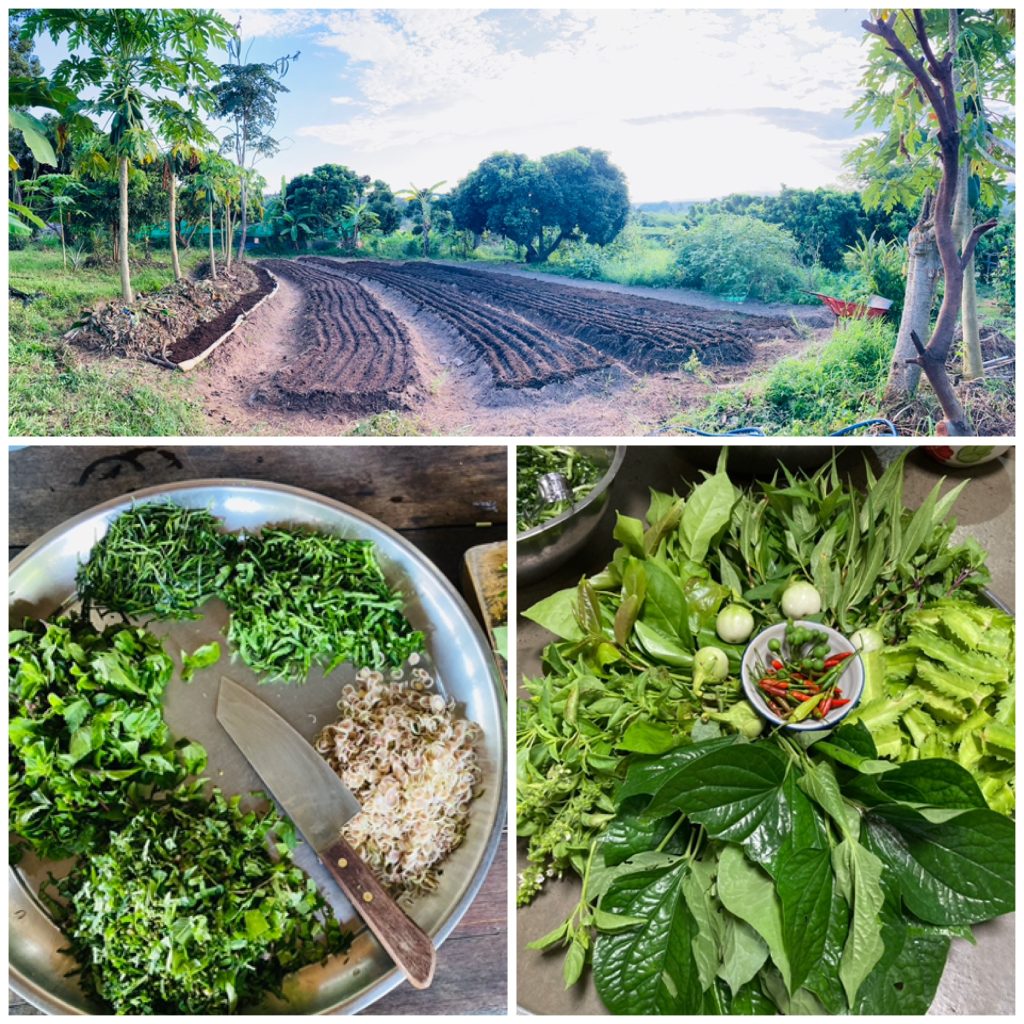
There is such a rich variety of vegetables, herbs and fruits on the land. Even the first ones that come to mind create this long list; eggplants, beans, okra, chickpeas, pumpkins, cucumber, carrot, chili peppers, tomatos, onions, garlic, basil, mint, oregano, rocket, lemongrass, galangal, turmeric, ginger, coriander, and some fruits like; lime, guava, custard apple, papaya, pineapple, mulberry, banana, passion fruit, and many more. As we see above, the harvests from the gardens first take their place on the shelves in the kitchen and then turn into extraordinarily delicious and artistic dishes in the hands of the kitchen team of the day.
It was always a joy to cook together and then eat together around the long dining table. With all the delicious tastes in my mouth, the nourishment in my body and having friends around me, I was feeling deeply grateful for these blessings of life.
Apart from gardening, farming or cooking, there were also some natural building works like; producing mud bricks, plastering, repairing old cob plasters, painting, or digging water ways for the heavy rains. Our number was remarkably growing when the participants of a new course showed up. Pun Pun hosts courses or workshops on self-reliant living, organic gardening, community living, natural building and natural health throughout the year.
There were so many joyful moments we shared. One of our favorite activities was to go to the Saturday market for some delicious food and drinks. Another excitement we shared was to go to the hot springs in Chiang Dao. At both expeditions we were jumping into the back of the pickup truck and enjoying the road trip with cheerful conversations and songs we shared. One other memorable experience we shared was the Halloween celebration. I always adore how groups of people can have a natural ability to self-organize around a topic they love. Magically everything gets arranged, all that is left for you is to enjoy. That day I guess we hosted around 50 friends and neighbors and had a blast! It is always so wonderful to see children laughing and having fun. Joy is contagious, isn’t it?
I just mentioned about the hot springs in Chiang Dao. Speaking of which, I recommend you to experience these hot springs and enjoy your times by the beautiful river there, streaming through a lush green forest. Chiang Dao -a northern town very close to Myanmar border- hosts Doi Luang mountain, third highest mountain in Thailand. Its beauty, as seen above, is visible from all around Chiang Dao.
The room downstairs that you see above was my humble and sweet home in Pun Pun. I settled in, placed by altar, burned incense, evoked my good intentions and prayers. In couple of days, I was more than comfortable and feeling safe as I was able to create a sense of belonging. Between you and me, I started to be quite good at cultivating this sense! So every evening, after the dinner, like every other person, I was retreating into my room, into my aloneness, filling the nights with reading, writing, meditating, singing or practicing ukulele. It was also the perfect time and space for deep listening and contemplating on the fresh inquiries that are emerging in my being.
In the first weeks it rained so heavily all day and night as it was the time when Typhoon Yagi hit North Thailand. My heart was heavy with the suffering of our world on many levels and my mind was very busy thinking about solutions and possible remedies. I was taking the online course of Plum Village; ‘Zen and the Art of Saving the Planet’ and also reading and contemplating on Deep Ecology and Post-activism. You can read through “What if the way we respond to the crises is part of the crisis?” where I elaborated on all of these.
For many years I have thought a lot about community building, visited some communities, and even took some steps to build one with close friends. Throughout these years I didn’t stop questioning the principles I hold onto or what I see as ideal. I contemplated on our need to be a part of a community. I looked closely at our humanly needs like safety, connection, company, approval, recognition, encouragement, belonging versus othering, etc. I needed to analyze what I find lacking and therefore in need of? I needed to bring awareness on my fears.
I see that my thoughts and feelings around the topic are changing and becoming more flexible over time. To live in a big family is undoubtedly a rich experience so I would be happy to open myself to a community from time to time, interact, give and receive, be nourished, and then return to my loneliness. Because I can be very good in my solitude. Yes, like everyone else, my life is based on movement and change.
Those of us, who feel enthusiasm for Consciousness’s awakening process in humanity, are open to meet with deeply ingrained individual and collective fears. By facing them, by shining the light of consciousness upon them, we gradually break free from the illusory barriers that separate us from each other. I see these times as part of a foundation building process which we will hand down to the next generations. I have full confidence that the new generations will have much deeper understanding to create peace within themselves and in the world. I believe our children will be able to build communities and live the lives we long for.
6 weeks in Pun Pun were filled with so many conversations, human interaction, shared stories, dances, songs, laughter and tears. I am grateful for all the friends for opening their heart and trusting our connection. What they reflected back to me from their hearts was an intimate gift, reaching me from that mysterious place of Love. Nothing can replace the warmth of this feeling and a sincere hug.
✨
PS. Some of the photographs of this post are taken by dear brother Chan, one of the members of PunPun. You can take a look at his photo collection on his instagram page: lazygotji
“Our own life has to be our message” ~ Thich Nhat Hanh
The direction we want to take in the journey of our lives is engaged with what we actually care about. We walk this path with the willingness of finding the ways to manifest our care and express our love.
Healthy and mighty forests of Northern Thailand
Yagi, Asia’s biggest Typhoon of 2024 hit multiple countries in Southeast Asia, leaving dozens of dead or missing. Thousands of families effected, thousands of homes were damaged or destroyed due to landslides and flash floods. Scientists have warned that as the world warms, typhoons can bring higher wind speeds and more intense rainfall. Warmer ocean temperatures cause tropical cyclones to intensify quickly. Scientists have linked this to the ‘human-caused climate crises!
When Typhoon Yagi reached North Thailand, I was there. Its impacts were very destructive. I haven’t seen such heavy rains in my life that poured down constantly for some weeks. Floods were everywhere. Latest news was informing us that people were dying, animals – including elephants- were dying. People became homeless. Huge areas of agricultural fields and forests tore down by the flood. In a smaller scale, I was watching the environment at the farm where I was staying at those days. So many animals -including snakes, scorpions and insects- were trying to find new homes for themselves and for their colonies. Some trees were swinging, having difficulty in standing still as their roots weren’t able to hold the soggy soil tight.
Everything was happening right under my nose which was very different from accessing the news through media. These devastating events were said to be linked also to human activity. Unavoidably this was reminding me of critical global matters that we are all exposed to collectively. Environmentally we face issues like; climate change, biodiversity loss, deforestation, exploitation of natural resources, pollution of soil, water, ocean and air, and etc. On the other hand, social and political issues we have to face are; wars, poverty, hunger, inequality, violation of human, animal and minority rights, colonization, forced migration, etc.
Such a heavy reality, right? We had to be aware of our footprint on this planet. NOW! Feeling the suffering we create as a species on our planet, my conscience was restless. Waves of grief were coming. Senses of loneliness, helplessness were pushing me to seek my community, my tribe. Senses of hopelessness and inadequacy was causing a tendency to do something right away.
Life is generous as it brings us what we need sooner or later. At those times I came across and attended an online course that brought me the whole collection of perspectives and understanding I needed in order to approach the current situation of our world and our suffering. This 7-week course was called “Zen and the Art of Saving the Planet” and it was offered by some monastic and lay members of Plum Village tradition founded by beloved teacher Thich Nhat Hanh who was a Buddhist monk, peace activist, and a poet.
I felt very lucky to be part of the community of the course. We were over a thousand people from various parts of the world, many of whom were activists working on environmental, human or minority rights, inequality etc. So many reminders, perspectives, practices were shared in the course which were very helpful to see the crisis in a wise way, cultivate insight and compassion, remember the significance of community and respond to the crisis from a more grounded, thoughtful, connected and effective position. Below I would like to share some of the gems from the course from which we can benefit in the midst of the current crisis. For sure course materials were so rich and diverse but I hope the brief list below will give you a taste.
~ Being Mindful: First of all, we need to be mindful of ourselves, of how we live our lives. To be aware of our thoughts, speech and actions, our consumption habits, we can review our place, our contribution or harm in life. With the right view and right action, we can be in service for the life we long for.
~ Acceptance & Grief: We need to accept the inevitable change of life and the world. We need to confront our fear and suffering in the nature of this change. Our individual and collective pain wants to be embraced so we need to give decent time to grief if we need to. Only in this way can we move to a more peaceful, fearless, inclusive and accepting, therefore more balanced and grounded state.
~ Impermanence: We need to remember that every being -including us, our loved ones, all the elements of nature- are going to die one day. The moment we accept death, peace finds us, a presence that is less fearful finds us. This teaching is there for us to recognize our fear. Can we befriend with it without treating it as an enemy? How can I embrace my fear because that is what it really wants; to be seen, to be loved.
~ Time of transformation: At such a pace, we need to acknowledge that our civilization will clearly collapse. But it would be wrong to read this teaching as the world and our civilization are dying out. Instead of imagining a sharp end, we can know that a transformation is coming.
~ Constructive Optimism: Instead of acting with stress, panic, anxiety, hopelessness, helplessness, we can realize what we want to create. This is radical positivism. When we are with our pain only, there are many things we miss seeing. For instance, when we see a tree that is going to die, we forget that it is alive. Likewise, it is also possible to choose to see love, gratitude, sense of connection or joy instead of worry, despair or anxiety. When we find the right path, there is always joy there.
~ We are not the masters: Anthropocentric view is narrow by its nature, advocating that only humans can save the planet. We need to remember that we are just a part of whole life. Even though we have a big impact on the devastation of life in many levels, life has a greater intelligence, power, resiliency and regenerational strength far more than human capacity. All our good intentions are limited and nature has its own way of responding to new unfoldings.
~ Do not hurry: We hurry with the belief that time is running out. But in contrast with our rush, mother nature has a different understanding of time. She is patient. It may take millions of years for her to heal her wounds, create new species that can replace extinct ones. Just as there had been so many eras on our planet. As Lao Tzu said; “Nature does not hurry, yet everything is accomplished.”
~ Right action: Right action in service of the Earth requires us to develop our different aspects. Can we embody these 3 qualities at the same time? Fearless warrior, conscious meditator and compassionate artist.
Zen and the Art of Saving the Planet course is repeated every year. If you are interested, you can search for it at the webpage of Plum Village: plumvillage.org
*
These issues also brought me closer to the notion of Deep Ecology which is an eco-philosophy that looks more deeply into the reality of humanity’s relationship with the natural world. It criticizes the narrative of human supremacy (anthropocentric environmentalism) and regards human life as just one of many equal components of a global ecosystem where the survival of any part is dependent upon the well-being of the whole.
One other source of inspiration had been the talks and paradigm shifting perspectives that Bayo Akomolafe suggests. He is a philosopher, professor, activist, writer and poet that comes up with the concept of postactivism. What do you do when the world kicks back? He says postactivism is not a formula for saving the world. Instead, it is the site where continuity becomes impossible, a crack opens in the totality and knowability of things, disrupting the exclusivity of human agency and inquiry, and expanding sociality to include things we hadn’t considered. Postactivism invites us to move beyond the binary thinking of “us versus them” thinking of traditional activism and engage in more open-ended, and transformative ways of addressing social and environmental challenges. Bayo also criticizes white modernity, accomplishment, success and result oriented, leadership-based, individualist and anthropocentric perspectives.
Bayo’s inquiries disrupt my learnings, beliefs and ideals. This shape shifting question of him enabled new and fresh perspectives to find room to open up in my understanding. “What if the way we respond to the crisis is part of the crisis?”
For further reading on Bayo Akomolafe’s works, you can visit his website: bayoakomolafe.net
*
I often find myself struggling with feelings of inadequacy about so many different things. This time seeing the suffering of the world, I point the finger at myself saying; “You are not participating enough to change things. You are passive and slow to take action.” Doing becomes an issue. Doing the right action -as a thought- becomes complicated. How can I be a fearless warrior that guides her fire in the most wise and compassionate way?
In fact, by putting all the tangled narrative of the mind aside and by being honest with myself, I see that there are valuable things in my life that I should take notice of. Listening deeply, feeling my heart, sensing into the voice of my essential Being, asking the right questions, contemplating, connecting compassionately, holding space for the other, giving attention and care, making them feel seen, asking their needs, smiling sincerely. And then illuminating all of these with consciousness and aligning them with my true nature. These are quite a state of doing in themselves.
I find these words of Thich Nhat Hanh so inspirational. In his essay called; ‘A Poem and a Peppermint Plant’ he writes:
“I don’t know what job you do every day, but I do know that some tasks lend themselves to awareness more easily than others. Writing, for example, is difficult to do mind-fully. I have now reached the point when I know that a sentence is finished. But while writing the sentence, even now, I sometimes forget. That is why I have been doing more manual work and less writing these past few years.
Someone said to me, “Planting tomatoes and lettuce may be the gateway to everything, but not everyone can write books and stories and poems as well as you do. Please don’t waste your time with manual work!” I have not wasted any of my time. Planting a seed, washing a dish, cutting the grass are as eternal, as beautiful, as writing a poem! I do not understand how a poem can be better than a peppermint plant. Planting seeds gives me as much pleasure as writing a poem. For me, a head of lettuce or a peppermint plant has as much everlasting effect in time and space as a poem.”
I think we just need to be true to what inspires us. This will be our contribution. Without rushing, we just let it evolve on its own…
PS1. I’d like to link another related article here; “Bali / Looking through the Lens of our Changing World”. There I wrote on the impacts of our civilization upon our dear planet, through observing life in the small island Bali which is overly occupied by tourism.
PS2. Some of the photographs of this post are taken by dear brother Chan. You can take a look at his photo collection on his instagram page: lazygotji
Heartfelt thanks to the kind invitation of my friends Ramphai and Greg (from Pun Pun Organic Farm and Learning Center), I found myself in a quite unexpected place, with the people whom I wouldn’t predict to meet. Life is very generous, blessing us with its surprising gifts. Here I’ll be telling you about such a valuable gift of inspirational connections and enriching experiences.
This essay is about the days of the gathering where P’gakeryaw tribe of Northern Thailand and Maoris of New Zealand came together for cultural exchange. The gathering took place in Ban Nang Tao village at the high altitudes of Doi Inthanon mountain that is close to Chiang Mai city in North Thailand. Isn’t it quite amazing to be part of such an event as a traveler and let your soul nourish from that?
For 4 days, we were guests of P’gakeryaw tribe who were so generous and kind to open their houses. So we divided into groups and stayed at a different family house in the village. Everyone developed intimate relations with the family they stayed with. So many stories and gifts were shared as well as the delicious local food cooked by the house holders. The video below shows some parts of the village.
During our times together, we explored many elements of the cultures of these two groups such as; language, stories, myths, history, local way of life and customs, beliefs, indigenous practices, traditional handicrafts, music, dance, and many more. We were either meeting at the coffee shop for some sharing sessions or we were exploring their indigenous way of living during our walks in the rice fields or in the forest.
The sharing circles where we listened to one another deeply and presented our hearts were very emotional. Below we see Ramphai while she was sharing her heart in one of those circles. Along with her husband Greg, she was the originator, organizer and the host of the gathering. I really appreciate her willingness to work for what she loves and values. Her efforts and contributions were priceless.
Coming to the sharings.. Maoris see reviving and keeping their languages alive as one of the main elements of restoring their identity. That’s why, before expressing themselves in English, they first used their own native language. I was very impressed by the way they introduced themselves. They stated where they came from, their mountains, rivers, oceans, in other words, the geographical signs of their home; then their families, tribes, and ancestors. Their strong presence and powerful expressions, their commitment to their culture, ancestors and traditions, their sincere connection with one another and the nature were very impressive. I couldn’t hold back my tears.
✨
Indigenous cultures are different all around the world but they share some common values and world views. Indigenous people have evolved and maintained knowledge that accumulated across generations. They gain this knowledge through direct experience, interacting with landscapes, ecosystems, elements and species. They teach us how to develop more caring relationships with nature because they regard each living being as having an important role in the cycle of life. This is understanding the sacredness of life. They have always known that caring for each other -the land, waters, plants, animals- is how they could maintain and restore balance with all of creation.
With care and respect, they developed their sensory capacities that they relied on for their survival. We can say that it is some sort of refined mindfulness. Some groups can put themselves into the viewpoint of many creatures or objects – rocks, water, clouds. By sustaining their culture, supporting the lives of numerous species, and guarding the well-being of our home -the Earth, they contribute to the diversity of life.
Coming to the brief story of Maoris; I learned that the colonization of the British began during 1840s in New Zealand. Maoris, indigenous people of New Zealand, were forced from their lands, alienated from their languages and traditions. Even, they were made to feel ashamed of being who they are. But now they are in the times of regaining their identity. After all those years of revolutionary improvements for the sake of Maoris, they feel lucky now. But they are fully aware of the pain their ancestors endured and the collective traumas they still carry.
On the other hand, the story in Thailand goes like this; When Thailand became a country and all the indigenous tribes came together under the same name, they found themselves in the danger of losing their identities. The governments took the lands and forests from them, saying that they would protect the environment. They even held these indigenous people responsible for forest fires or floods. So, the tribes couldn’t understand why the lands were given title deeds or why the trees were cut down. They felt that they are losing their spirit.
2 groups also exchanged information on the tools they use for local and national organization. They shared experience on the effective ways to protect their lands against governments and local authorities. For example, Maoris conducted some serious researches in order to defend the rights of nature and people. They recorded the talks of their ancestors, who had been living their particular way of life for centuries, and submitted these to the government. Their main purpose was to explain how the ocean was vitally important to them. We learned that while governments in New Zealand try to dominate particularly the oceans and coasts, in Thailand they set their sights on the forests. Mountain or forest tribes here are under pressure and having really difficult times.
What Grandfather Patijani’s son said to Maoris was very touching; “You are here with us now. My child will be there for you in the future.”
P’gakeryaws explained us their relationship with nature, mentioning about the principles they follow in this relation. For them, the uppermost part of the forest is the Goddess. They can’t cut any trees there. They can’t do cutting down in the valleys neither where the mountains meet because they are where the rivers and creeks are settled. But they can do agriculture in the intermediate area between the upper and lower parts of the mountain but under one condition. They mustn’t have seen some particular animal species (like birds) in the places where they intend to do agriculture.
They hunt under the same condition that they mustn’t have seen particular kinds of fish in the area where they do fishing. Before hunting they ask for permission from the forest first. If they intend to hunt deer, they only hunt it so they take action according to their intention. If their intention is to hunt just one animal, they don’t hunt two. If they kill an animal, they definitely eat it.
We were lucky to be there at the time of rice harvest so we had the chance to observe the villagers while they were working collectively. They explained us about their agricultural practices in detail. Regarding farming, they work with shared labor. In other words when it is your turn, everyone in the village come together and work in your garden. A family farms in one particular area for a year, then moves on to another area. They call this rotational farming. After the harvest, they leave a portion of the harvest on the land and perform a ritual in which they thank the land.
Grandfather Patijani says: “Take only what you need and stay rich. It is because when you take only what you need, the nature you live in remain rich. If you know how to listen to nature, your life becomes easier. You start to see that resources are already flowing to you.”
One of the most outstanding handicrafts of P’gakeryaw people is weaving. They weave various pieces of cloths and bags where they use natural dyes. The authentic patterns on these pieces symbolize so many different things like the cycles of life and nature.
At the closing session on the final night, P’gakeryaws gave a little concert. Loveliness of their music, humbleness of their instruments, simplicity of the lyrics, and the way they sing their songs without ever trying to be good was so beautiful. After that Maoris did Haka, their ceremonial dance. What a strong dance! Just by watching it, your heart beats faster. Strong or fluid body movements, sharp and fierce facial expressions and high voices not only express courage and fearlessness but also respect. Video below is a little section from their rehearsal.
I was in the middle of two indigenous groups who were doing their best to keep their cultures alive, despite all the hardships they have to overcome. Their sense of union with their community or tribe touched me so deeply, leaving me with the grief of not being a part of a community. Along with a few other friends there, we seemed to be representing the generations who had already lost or were about to lose their tribes. The sense of longing for belonging was so significant in my heart.
Even though I have so many fulfilling connections and dear friends that I feel grateful for, why was this feeling of incompleteness with me? Was that really true that I was lonely?
Maybe the community I long for has a different form or appearance compared to the communities our ancestors used to live in. By this new form, it may be more in harmony with the changing reality of humanity and the world. It is redundant and meaningless to expect continuity in the ever-changing nature of life so the form of the communities may be changing as well. I trust that we as human beings -moved with our survival instinct- are developing new ways to be together even though modern age -by its nature- puts us apart.
What matters is our openness and devotion to build and maintain sincere human connections where we speak our truth, listen and hold space for others, make them feel seen. By this way we can create safe grounds for one another. For sure the warmth of a hug is priceless, but these people whom we see as a family can be anywhere in the world. Maybe our new tribes will be composed of people from different landscapes and cultures. If the ancient knowledge of our own ancestors disappeared some time ago, we can benefit from the knowledge of the indigenous elders that can still hand down their ancient knowledge in another part of the world. They are also our ancestors, aren’t they?
Certainly, we shouldn’t disregard the basic psychological needs of our human nature such as connection, safety and visibility. But by honest and true contemplation, we may realize that actually we are not separate from the whole totality and the whole flow of life. No separation is the absence of lack. No separation means peace and harmony with what is. Then we turn back and look again at our loneliness and our longing (for our lost connection with our ancestors, with our tribes). And see that they all burn up in the intimacy of no separation.
In this essay supposedly I wrote about 2 indigenous groups from 2 different parts of the world. But this is also my story, your story, our common story as humankind. Their dreams, hopes, happiness, pain, longing, joy, wisdom, failure are also ours. Thanks to all the ancestors of our history, that each of us carries the seeds of wisdom inside us. All we need to do is open the box of our consciousness and tap into what had been handed down to us as ancient wisdom.
✨
PS. Some of the photographs of this post are taken by dear brother Chan. You can take a look at his photo collection on his instagram page: lazygotji
Regarding Cambodia I’ve divided my writings into two parts. This essay tells only about Angkor Wat and the other is about the whole other destinations I’ve visited in Cambodia.
Now I am going to take you to a mystical journey to the magnificent ancient settlement Angkor Wat. It is a highly respected archeological heritage as it is the largest religious monument in the world. It is located in northwest Cambodia, just 6km away from the city Siem Reap that is the gateway to this spectacular site. My expedition to Angkor Wat started on an early morning. Watching the sunrise behind the dark silhouettes of the temples was a magnificent start for the day (above).
Stretching over 400 km², including forested areas, this archaeological park contains the magnificent remains of several capitals of the Khmer Empire of the 9th to the 15th centuries. It is in Unesco World Heritage list.
Entrance fee is quite expensive. I chose the ticket for one day that was for 37 dollars! But then I found the price understandable after realizing that this massive sized archeological park needed support to be restored. It hosts almost one million visitors a year and I hope the collection of money will benefit for the well being of this great heritage. You can explore here by cycling. Since I wanted to see as much as possible in a limited time of one day, I chose to jump on the tour van of a group of Spanish people I met.
The whole site hosts almost 50 huge temples. While early Angkor temples were built as Hindu temples dedicated to Lord Vishnu, after the kingdom converted into Buddhism, Buddhist structures took their place in the whole area.
One of the causes for Angkor Wat’s fame is its extensive decorations, motifs, depictions of Hindu epics on pillars and walls.
Angkor Wat is an amazing blend of spirituality and symmetry, a great and unique example of humanity’s devotion to its gods. A young monk blessed me in the main temple. I was not only entranced by this magnificent massive structures but also having a mystical experience feeling the light of Buddha in my mind and heart.
One of the most spectacular temple is Ta Prohm (above). Its distinctive feature is that it looks like it has been swallowed by the nature. It has an abandoned feel to it.
Hundreds of years old huge trees spring from the structures and rise up into the sky. Walls are carpeted with lichen, moss and creeping plants.
Ta Prohm was in use until 15th century. After that it was abandoned and taken over by nature. Then it was rediscovered in the 19th century.
Bayon also known as the ‘Face Temple’ is one the most impressive temples in the whole area (above). It is a perfect monument with finely balanced elements and proportions.
Its 54 gothic towers are decorated with smiling faces of Avalokiteshvara that is a Bodhisattva who embodies the compassion of all Buddhas.
As you walk around, numerous heads are visible at any direction, full face or in profile, sometimes in level with your eyes, sometimes staring down from above.
When I visit this type of ancient places I feel like I am on a journey in time. But here the temples were so mystical, even taking the notion of time away from the mind.
The site also has an enormous system of artificial canals, dikes, and reservoirs that are the integral part of the overall site design. This massive water system was providing the needs of about 750,000 residents in the world’s largest preindustrial city. The water was also used for irrigating crops like rice, which served the Khmer as currency. If you take a one day ticket, it is allowed to enter the site a day before in the late afternoon. So I took this chance and cycled along some points realizing how massive the whole area is. It was amazing to catch the sunset near this reservoir.
Life goes on in its simplicity near the timeless structures (above). Farmers grazing their animals at the rural side of Angkor Wat. * Now come join me to explore the other parts of Cambodia in my next essay. There you will get an introduction into the country’s history, culture, rural side, coastlines and islands.
Two weeks of travelling in Cambodia provided me a basic outlook about the country. First I’ve visited Siem Reap together with its surrounding like the floating villages and the great temples of Angkor Wat. And then visiting the capital Phnom Penh gave me a broad idea about the recent tragic history of the country. After that I made my way down to south to Kampot and Koh Rong Sanloem to see the coast lines and the islands. So in this essay one by one I am going to take you to these places and display what I have come across in Cambodia regarding nature, history and the culture. I have singled out a seperate writing to Angkor Wat. You will find all about it in the other essay. Ok, let’s begin.
I entered Cambodia overland from Thailand using Chong Chom border check point and arrived at Siem Reap first. It is a popular destination in northwest Cambodia as it is the gateway to Angkor Wat. In my opinion there is not much to tell about the hyper touristy Siem Reap. The only reason I was there was to visit Angkor Wat. The cities are losing their distinctive qualities and becoming alike world wide due to the globalization. Because of that, to trace the unique properties of the countries I prefer to see the rural areas. Because they are the perfect places to observe the culture in its authentic way. When I heard about the floating villages close to Siem Reap it attracted my attention right away. So I payed a visit to the floating village Kampong Phluk that is 30 km close to Siem Reap.
You come up until a point with a vehicle where the road finishes. This is the point where the Tonle Sap lake starts. Great Mekong river that comes all the way from north Laos feeds this lake. You take the boat to go to the floating village.
All the structures, houses, schools, monasteries, markets, health clinics are built on stilts on the Tonle Sap lake. Since it was the rainy season the water level was quite high. At other times when the lake loses its mass the stilts become more visible. The boat ride along the village gives an opportunity to observe how the life is engaged with the water here. I adored their humble and simple way of living.
The community largely depends on fishing for survival in wet season and during the dry season many turn to farming to supplement their income. In the rainy season the lake reaches to ten times more of its size, bringing rich alluvium onto the lands. Therefore this creates highly fertile soil for agriculture.
Above is the floating market where the villagers bring their goods to sell. It is located by the mangrove forests in the flooded areas. After being in Thailand, the culture didn’t really seem so different in this neighbor country. The people’s faces, the tone of the language, the food and the markets were looking quite similar. Around 18 million people living in the country and it attracts around 3 million tourists a year. Tourism has an important role but mainly textile industry is supporting the economy. China has been investing in Cambodia to a large extent. Nevertheless regarding poverty Cambodia is in rank number 158 amongst 180 countries. After discovering Siem Reap and its surrounding and visiting Angkor Wat, I made my way to the capital Phnom Penh. The reason that brought me here was to learn about the tragic recent history of the country by visiting Genocide Museum and Killing Fields.
Phnom Penh fell into Khmer Rouge regime from 1975 to 1979, immediately after the end of the Cambodia Civil War. The Khmer Rouge forcibly evacuated the entire city after taking it, what has been described as a death march. All of its residents that were evacuated were forced to do difficult labour on rural farms. Many of them starved to death as a result of failure of the agrarian society. Hundreds thousands of people perceived as educated or political enemies were systematically murdered or driven into exile. The mass killings are widely regarded as part of a broad Cambodian genocide. Finally the Khmer Rouge were driven out of Phnom Penh by the Vietnamese in 1979.
Tuol Sleng Genocide Museum is one of the places that displays this tragic history. This building was once a high school but then turned into a prison by the regime’s forces. The classrooms were converted into tiny prison and torture chambers and all windows were covered with iron bars and barbed wire to prevent escapes and suicides. It soon became the largest centre of torture in the country that was just one of at least 150 torture and execution centers. From 1976 to 1979, an estimated 20,000 people were imprisoned, tortured and killed at Tuol Sleng.
A visit to Tuol Sleng is a profoundly depressing experience. It demonstrates the darkest side of the human spirit that lurks within us all. Photograph of prisoners display the records of the barbarism. Virtually all of the men, women and children pictured were tortured and later killed. I met a man in the garden of the museum and listened to his story. He used to be a prisoner here who was released at the age of 8. He, his wife and I couldn’t help ourselves but cry to this great sadness.
Some of the prisoners were transported to the extermination camp of Choeung Ek that is also known as Killing Fields. Killing Fields are a number of sites in Cambodia where collectively more than a million people were killed and buried in mass graves by the Khmer Rouge regime. It is a silent place today, where visitors can learn of the horrors that unfolded here decades ago. More than 8000 skulls, arranged by sex and age, are visible behind the clear glass panels of the memorial stupa. While walking in the surrounding you can take an audio tour and listen to the voice recordings of the prisoners. It is so heart breaking really to learn about the deep ignorance of humanity, barbarity, despair and great suffering. It is estimated that almost one third of the population get killed during these times. All this data enables every visitor to build empathy to understand the current state of people in this country. Almost everyone you see on the streets have tragic stories either individually or in their families.
Leaving Phnom Penh behind I hit the road to south coast of Cambodia. Since it is a quite small country I reached my next destination to Kampot by a 3 hour shared taxi journey. Kampot is a relaxed riverside town just a few kilometers close to the coastline. It has a laid back vibe with some backpacker guesthouses that line on the banks of the river. And the small cute town center is composed of 19th century French colonial architecture. As always my interest was into the rural areas.
I explored the surrounding area of Kampot with a tuk tuk. They were pleasant rides on the dirt roads through to the village life of Cambodia. Monsoon rains were dominating the days.
I saw many farmers working in their fields and rice paddies. The river meandering along the region plays a big part in the abundance of agricultural production. Above we see some traditional tools and baskets used in agriculture. The ride around Kampot also takes you to the beautiful Secret Lake and couple of caves.
The region and the town are known for high quality pepper which is exported worldwide. You can visit pepper plantations and attend a free guided tour to see how pepper is grown, harvested and processed.
Prek Tuek Chhou river flows through Kampot. Especially around sunset times I recommend a traditional Khmer boat tour that takes you to beautiful places along the river where the flora, fauna and people dwell harmoniously. Tour voyages up the river towards the heart of Bokor National Park. By the way, 25% of Cambodia consists of national parks.
There is also a small seaside town Kep that is 30km south of Kampot. I paid a day visit here and didn’t hang around so much. Because before going back to Thailand for the south part of it, I was looking forward to spend my last week in Cambodia in the islands and discover the vibe there.
I chose Koh Rong Sanloem island to visit as it was said that it was a quieter island compared to the other more touristy ones. First you need to arrive at the coast at Sihanoukville town then take the ferry to reach the island. When I was approaching for the first time to the shores of the island I was already amazed by the lush green jungles reaching the sea.
Its eastern side, facing towards the mainland is less exposed to the weather and the monsoon, that’s why I chose to stay at the east. Beautiful guesthouses, cute little bamboo huts were in line along the beach.
Koh Rong Sanloem is famous for its pristine white beaches and clear turquoise waters. It was such a pleasant experience to walk barefoot on the soft and glittering white sand. I so much enjoyed the quiet times of the island in the off season. You could hardly see people here and there. It was like I was alone with the island itself.
The island is mainly hilly and the interior is almost entirely covered in dense jungle. It was such a great experience to wander around in the tropical jungle wilderness in the heavy monsoon rain. When you cross the island from the hills to the other side you come across some yellow beaches. Lazy beach is one of those. The waves were so high and strong in this side that is facing the open ocean.
Sitting at the terrace, listening to the rain I am so glad to be in this silent island. This silence is going along with the silence within. Seeing that the mind is always there, I am letting myself intuitively listen to what is there beyond the mind in the background. In the most conscious way as possible. The recognition of the limitless source inside is gradually bringing an immense meaning into life.
Great Persian poet, beloved Hafiz is voicing my heart in the most beautiful way; “When the words stop and you can endure the silence That reveals your heart’s pain of emptiness Or that great wrenching sweet longing That is the time to try and listen To what the Beloved’s eyes most want to say.”
In this essay I am welcoming you to the very special place Dersim that is like a hidden jewel in Anatolia. Dersim is a vast land in Eastern Anatolia Region of Turkey. My journey took place mainly around the provinces; Tunceli and Erzincan and around Pülümür and Munzur valleys. The main reasons that took me here are; its breathtaking wild nature and the tradition of wisdom it had been holding through many centuries. There is something so distinctive, deep and esoteric about this place. Its depth is so alive in the energies of mother nature, in people’s hearts and traditions. Dersim showed itself to me in such a way that it became a sacred home I cherish in.
The best way to reach this region is to take the Orient Express train from Ankara and get off at Erzincan after 700km. This train journey is a special experience that takes you all along the central plateau of Anatolia where first you see vast flat fields. Then you reach Fırat river that is one of the longest rivers of Turkey. Railway proceeds along this river for hours and hours and the view at every point is magnificent.
Erzincan (above) is a mountainous area. In the following days I would be exploring this region quite in detail.
My first stop was at Çağlayan (Girlevik) Waterfall in Erzincan. This was the place where I asked for permission from the energies to be welcomed into the beauty and wisdom of this magnificent lands. I expressed my commitment to be pure and loving to each and everything that would be offered to me.
Pülümür Valley is a spectacular canyon-like valley uniting Erzincan and Tunceli. The road and the river meander side by side between red coloured rocky mountains. If you are lucky you can see wild goats wandering around at high points.
After you reach Tunceli over Pülümür Valley, you go into another one; Munzur Valley. Strong Munzur River accompanies you all along the extremely curvy way. This view above is from a cliff named ‘38 Kayalıkları’ that has an important place in the local people’s memory due to some tragic events happened at 1938.
And eventually I arrived at little town Ovacık which is seen as the heart of whole Dersim. A wide line of epic Munzur mountains can be seen from here. (above) There are many routes going into the heart of these rocky mountains that take you to different valleys, waterfalls and upper plateaus. Like; Havaçur, Ziyaret, Fkirik, Karagöl, Rahan, Satır, Kırk Merdiven, Kepir, Mercan, Işıkvuran. It is a paradise for trekking. Could it be a better place for camping (above)? Munzur mountains and Munzur river in the front and at the back nice green fields that the cows come everyday for grazing. In the following days I would be staying here with my friends.
It was pleasing to see that here in Ovacık, agriculture is still away from industrialisation and chemicals. The farmers are conscious in their productions and they take care of the well-being of their animals. The locals were bringing us fresh harvested vegetables from their gardens and colouring up our days with their warm hearts, great hospitality and generosity. Serdar was one of them. (above, right) Sometimes alone, sometimes with his lovely family, he was coming by everyday to graze his dear animals. Our talks always warmed my heart. In our camp, we all rejoiced in every moment together here. We enjoyed our company while cooking, eating, swimming in ice cold water, sleeping under willow trees, having long conversations, hosting many visitors each night around the fire, making music, singing… All were touching experiences that gave way to dear friendships.
In Dersim, open-mindedness and understanding is always there in people’s words and glances. In the roads of Ovacık, it is ordinary to see an old village man sitting with a mohawk girl with many tattoos. All differences are welcomed with no distinction which is not so common in the conservative mid parts of Anatolia. From the young to the elders, there is sincerity and dignity in all people’s attitudes. I find the egos more content and humble. This is giving me the idea that spiritual virtues that is formed by beliefs and traditions of ethnic origin is penetrating into life. (I will tell more about these in the lines further below) Despite that it is a remote area in between the mountains, Tunceli has the highest rate of literacy in Turkey. I have met many people who have deep knowledge on many different subjects like history, music, belief, folk-literature, sociology, antropology, medicinal plants and healing. What impressed me the most was that all these people were so attentive on the conservation of the heritage of old knowledge that has been passed onto them. Old seeds are preserved, nature friendly old techniques of agriculture are unexceptionally applied, old tales, stories, musics, the wisdom of healing, all are recorded.
There is an immense depth in the talks of elders. You learn many things from them about the history and traditions. The woman above on the right is Grandma Gülsüm. She speaks in Kırmançki which is a dialect of Zaza language that is used in this part of Anatolia. I didn’t know even a word from this language but it wasn’t an obstacle for us to communicate. Her eyes, her embrace were telling me many things. With her sentimental old voice she sang us a requiem. By this way she expressed the loneliness and the grief she has been holding for many years. It moved all of us into tears. There are some old traditions that are still alive here. For instance, women get prepared before dawn, then at the time of the sunrise they pray to the sun. Another tradition is Gağan; at the last Thursday of the year people clean their houses in detail with vinegar. They put some supplies in front of the houses of people who are in need. Again on a Thursday, at the breeding season, after the newborn lambs and goats are fed enough with milk, people celebrate the outgoing of the new borns into the nature.
Anything you learn about a geography or a culture beforehand can not take the place of the taste of experiences you have at that place. Here seing the mountains, valleys, rivers, wild animals with your own eyes is utterly different. Here listening to the people’s stories, memories, griefs, longings, dreams is totally different. It is a unique experience indeed. Now I’m going to tell about the spectacular views I wittnessed during my treks into the heart of Munzur mountains.
I did 2 one-day treks into two different valleys; Kırk Merdiven and Mercan. They were really remarkable experiences to explore the gates of Munzur mountains that gift magnificent landscapes, rivers, waterfalls and flora. It is an area where mostly you can see no tree at all, no rock to go under to cover yourself from the scorching heat of August.
On one side I was letting myself into the breathtaking scale of the rocky mountains, on the other side I was walking fully watchful, knowing that I was in the wild. The valleys were so silent. Once in a while I was hearing the yells of the raptors flying above. Sometimes I was screaming towards to the grand rocks and listening to the echo floating in the valley.
Knowing that I was in the wild lands of bears and wolfs it was interestingly giving me a strong life energy that I felt deep in my cells. Rarely there occurs some bear attacks in the mountains. With curiosity I listened to many stories from the locals about bears. I asked many questions like what is their nature, how do they act and so on. So to speak, I called them. And they came! One night I saw a young one near the road in Munzur valley. Ahh how cute and adorable he was. When he saw us suddenly, he got excited and didn’t know what to do but just sat on the ground with wonderment in his eyes. And on another night on fullmoon, an adult bear came to our camp site. As hearing some sounds around the trees, my friends targeted the light into the darkness to see what was happening. Then they came face to face with the bear. Most probably because of the sudden strong light, the bear started to chase after my friends. I hide myself in the tent but felt the forceful footsteps of the bear running. Luckily nothing happened. We then understood that he was there for the wild apple tree. We kept on tending the fire all night long till the sunrise and laughed at our scary but lucky experience.
In winter all the groundcover is coated with snow. In summer people graze their animals at the upper plateaus which is mutually used with wild life. Fauna consists of many species; wild goats, partridges, eagles, brown bears, wolfs, wildboars, rabbits, caracals, martens, wolverines, red spotted trouts. There had been some traces found that indicate Anatolian and Persian leopards are still existing in the area.
Wild goats are accepted as sacred here. They are taken as the guides that know about the wild life more than humans. Here it becomes reversed, here animals, trees, rivers, rocks become the master. (wayir)
Regarding the biodiversity of flora, Munzur mountains is an important region not just in Turkey but also in Europe. Here, around 1500 different plant species are recorded. 228 of them are endemic. At this hot season of August it was quite surprising to see many types of medicinal plants and bushes even in the parts where the water can not reach. Especially the plant diversity along the rivers was remarkable.
Due to this biodiversity of flora, beekeeping is quite common in the whole region.
Unlike Kırk Merdiven valley, Mercan valley was greener due to the river that flows along the valley bottom. This is Mercan river (above) that feeds Fırat river which is one of the largest river of Anatolia.
Even in this arid season it was pleasing to see the river flowing this much strongly. Along the river we see many different types of trees like; oak, poplar, willow, juniper, elm and ash tree
In Mercan valley as you proceed upper you come across with some natural ponds. This clean clear water may be the most coldest water I have ever put my feet into. In couple of seconds your body starts to get numb.
I enjoyed each trek in this magnificent landscape of Munzur. They filled me with excitement, joy and admiration.
People of Dersim see Munzur river as sacred. It really touches my heart to see a tradition who takes the elements of mother nature as sacred. And it is common here. They take rivers, old trees, wild goats, the sun, the moon, the polar star, the fire as sacred. It is like the mark of the old ancient times when God was not seen as a seperate entity from mother nature. Many people pay visits to the source (above, right) of this gorgeous river, they pray and give their blessings on the water. This freezing cold water gives a remarkable vitality to your body, mind and spirit.
In my travels in Nepal, India and Thailand I had the chance to dive deep into the discovery of wisdom by the gifts and blessings of many teachings and teachers in Buddhist, Yogic traditions and Advaita Vedanta. I learned meditation and I have greatly benefited from having meditation as the main practice in my life which gave me an immense inner peace and showed me the reality. So for some time I’ve been offering sessions and meetings on meditation in the places I pass by in my travels. I talk about the fundamental foundation of meditation, give guided meditation sessions even to the small groups of people. Here in Dersim I had the chance to organise two ‘Introduction to Meditation’ meetings. It was two beautiful and beneficial meetings for all of us. I was so delighted to offer these by sacred Munzur river. I do my meetings on donation base. At the end of two meetings we donated all the contribution to the trees that will be planted near the source of Munzur river. May them bring food and shelter to many animals. May them bring shade, fresh air and healing to many people.
One day we went on a day journey back to Pülümür valley in Erzincan. In the little village Armağan there was a harvesting festival of the special heirloom variety of wheat called Karakılçık. In the whole area the production of this particular seed is promoted. Formerly I worked as a seed saver in my life and this subject is always in my attention. I still try to do my best to create awareness on going back to using old seeds and protecting our heritage of biodiversity.
The festival started with the prayers of Zeynel Dede (above). Dede is the spiritual leader of the community. Packages of seeds distributed to the participants. We listened to the traditional songs of local musicians. We gathered around abundant big tables and ate this delicious traditional food called Şir or Zerbet.
One of the common practices of the belief here is performing visits (ziyaret) to natural sites that are believed to be imbued with sacredness. I had chances to visit some of them like Ana Fatma, source of Munzur, El Baba and Çirik. At the day of the festival, my experience at Çirik was one of a kind. This visit is to an almost thousand year old juniper tree (above) that is in between some mountains that probably I can not find again. It is believed that the tree holds the spirit of two enlightened women. As we arrived at the point a strong energy embraced me right away. I sat under the tree, closed my eyes and immediately found myself in an immense consciousness. It was as strong as the powerful energy I experienced by the sacred mountain Arunachala in India. There are some points at this planet that hold a high powered magnetic field. And at those points if you are capable of opening yourself to the energy you can go beyond the mind and meet the depths of your true nature. Feeling the blessings shed me into tears out of love and gratitude. The impact stayed with me more than couple of days.
At the end of the day we all went to another village for a magnificent feast. Almost fifty people sat by the same table which was garnished by many different traditional food. What an abundance, what a generosity. Then the night continued by the fire with traditional musics of many local musicians. We sang altogether and celebrated the sisterhood, brotherhood of mankind. In this essay I need to tell about the tradition of belief that is distinctive here and it has a big impact in people’s perceptions and way of living. Alevism is an old tradition of belief that is also practiced in this part of Anatolia. Alevis are found primarily in Turkey among ethnic Turks and Kurds and make up somewhere between 10-20% of Turkey’s population. Most Alevi activity takes place in spiritual sisterhood and brotherhood. One of the main practices of Alevis is the Cem ceremony that features music, singing, and sometimes dancing (Samah) in which both women and men participate. The songs with mystical poetry in their lyrics are sung. The ritual instrument known as bağlama (a string instrument) is played. Because of this old tradition Alevis have a significant role in Turkish music and poetry.
When Alevis say; ‘God is one’, they don’t see God seperate and apart from all the plurality or diversity of the universe. To make a distinction between the creator and the one that is created is plurality. And plurality is the separation of pure consciousness from the divine source. It is seen as an illusion, a veil alienating creation from the ultimate reality. They see God as the all-inclusive completeness.
I would like to finish with the song ‘Çem Vano’, of a local but a very famous musician Mikail Aslan. I believe it will bring you the sacred wind of Munzur mountains and rivers: https://www.youtube.com/watch?v=YxZ3dJIpBgI
**In this essay, there are some excerpts I’ve used from the report of Dersim Ecology Council that is a collaboration of many academicians from different disciplines. The name of this work is: “II. Dersim Şifa Geleneği Sempozyumu Raporu”
Northeast Turkey is a special part of this big country with its old evergreen forests, high mountains, beautiful plateaus and deep valleys. If you are a forest and mountain lover visiting Turkey, you should definitely come and see this part. The city Artvin located in this region is one of the greenest cities in Turkey that reserves magnificent vast views of every tone of green. Besides it hosts a traditional way of living that hasn’t lost its touch with nature.
This grafitti on a wall in Hemşin is delicately telling about the life here. East Blacksea region has a harsh mountainous geography and tough climate with so steep slopes and dense forests. Nomadic life with animals transits all year long; descending to the valleys below in winter, ascending to the upper plateaus in summer. Therefore men and women have to be seperated at some parts of the year. You can see the mark of this life style in the lyrics of traditional songs. First two lines always tell about the nature but the second half expresses the longing of lovers. Despite this condition of life, the joy, the sense of humor of the people are so inspirational.
Maçahel is a region of Artvin around the border of Georgia. It consists of 18 villages at very steep slopes, 6 in Turkey, 12 in Georgia. It is a heaven on earth with spectacular mountains, forests and evergreen alpine pastures.
In winter the landscape is covered with snow. In summer it constantly rains and the mountains are covered partially with clouds or fog. Exactly these times last year I was in Thailand. These views and the climate were reminding me of my days there at monsoon season. I loved to spend some parts of summer in these misty greyish tones and got wet under the rain.
This region has a high importance in terms of natural old forests, biodiversity and beekeeping. Sudden height differences in the mountains, forests and rivers bring in the ideal habitat for many species. These mixed forests have rich flora with a high ratio of endemic property and has many species like; beech, spruce, chestnut, hornbeam, linden, birch, abies, acre, oak, alder, walnut, aspen, boxwood and hazelnut. And many berries like blackberry, raspberry and blueberry. In terms of fauna, this region is home for bears, goats, wildboars, jackals, otters and many different types of raptors.
This time I was not alone but with my old dear friends. It was such a beautiful experience to explore this region altogether with the warmth of our sisterhood.
We started our route from Kemalpaşa on a heavy rainy day. Then we reached Borçka over Hopa. Our first stop was at this beautiful lake Karagöl in Borçka (above).
Then we entered into magnificent valleys in between dense forests. We were now in Maçahel (above). After passing Camili village we entered into Efeler Natural Conservation Area. Some settlements, little villages and hazelnut fields started to show themselves in the lush green landscape.
Amazed by the wild nature we proceeded in the bumpy roads and arrived at this humble but pretty guesthouse Bumbulay where we would be staying for couple of days.
Bumbulay is run by this beautiful local family above; Kenan, Reyhan and their little son Ali. From the very first moments we were welcomed by their warmth and great hospitality. And they were also so joyful. Mashallah! We learned many things from them about the area, wild life, the way of living and the culture. Hearing about their memories from the past or their daily experiences we started to know more and more about the region. On the top right side, we see the traditional snow shoes. This region is a gene conservation reservoir of Caucasian bees. There are many beekeepers here that still use traditional methods. Oh and the honey was so delicious and fully natural.
Using this guesthouse as a base we exlored the area mostly on foot. Here is a heaven for trekking but you should get a proper orientation if you are willing to go deep into the forests. Going from one valley to another, it was such a delight to see all these beauties and breath in the fresh air. It healed all of us.
This region has many rivers running along in each valley. They are bringing life to each and every corner. What a blessing. Each time we took our chance to present our deep gratitude to the water.
This region has a rainforest ecosystem therefore there is high humidity. Ferns are coating all the groundcover (top right, below). Rhododendrons (local name komar) are constantly decorating the nature (top right, above). I used to see them at some foothills of Himalayas in Nepal, they were all over the place there. The bees produce honey from rhododendrons as well. The locals call this honey ‘deli bal’ that means crazy honey. If you eat more than couple of spoons, you may see the fairies!
We also paid a visit to the magnificent Maral Waterfall. Here the water falls from 65m height. It has a disorenting scale which you can understand when you look at Filiz standing in the water in the picture above, right. This summer gifted me a lot of visits to many different waterfalls in many different areas like, mid parts of Turkey, here and Georgia.
Ahh how silent is the forest and my mind. Wandering in the heavy fog, the notion of time and space disappears. We left Efeler behind and hit the road this time to the remote places up in the mountains. On the bumpy and slippery roads we drove for hours and hours next to steep cliffs when thick fog was blocking almost all of our view. It was quite an adventure.
But then the view above was our gift when we finally made it to the Curdipura plateau. (2200m) This magnificent view of the ocean of clouds rised up and up and reached us. We let it go through, feeling the soft touch of the clouds on our skin. Now we were not more than a couple of kilometers away from the Georgian border.
After we started our descend we passed through spectacular mountains and forests. Were we in Turkey or somewhere in the alpines of Switzerland?! There was a strong river passing through the valleys and we saw many springs along the way.
As we went down again from the mountains we stopped at this purely beautiful lake Karagöl at Şavşat (above). How good it was to meet with the warm summer sun again. In the afternoon we also visited Cehennem Deresi Canyon which is another beautiful attraction of this area.
Along the way we passed through many villages and fields that had been opened for agriculture. We were so pleased to see the traditional way of living that hasn’t lost its authenticity. These wooden structures called Serender or Nalya (above) are used as storages for grains. Talking about this area we need to mention about tea production which is one of the main sources of income. In Hemşin organic production is promoted. This old local lady was harvesting fern to use as an organic material to support her tea plants.
Horon is the traditional dance of the people of Black Sea. They have a high enthusiasm to dance in this circular form of Horon. In the center a man playes tulum. (traditional instrument in the form of bagpipe) There is always a leader who leads the groups and give instructions about the quite complicated different styles of the dance. It is a pretty lively dance where the arms, legs, shoulders move rapidly in cycles. At first times it was quite surprising to see people along the roads who park their car aside, start a high volume traditional music and dance. We also didn’t miss our chance and did exactly the same. It was such a fun and we burst into laughters.
Our journey continued with an overnight stay at Nihayet’s family house in Kemalpaşa. Then we spent some days at the beautiful cottage house at the mountains of Hemşin that Derya and Filiz had rented for this summer. All were so lovely experiences. We applied hanna on our hands as a reminder of these delightful days.
Most of the days were rainy and foggy. Going on walks in the surrounding, having delicious conversations, reading, writing, cooking together, we enjoyed to slow down and rest within our company. It was purely peaceful.
Today is my 40th continuation day in this life. In this life that is just a dream that will be over in a blink of an eye. And there is much more than that. The entire history of existence arise as this one single moment. It took all of that for you and I to be here. Beginning with the simple reorientation of attention, intuitively sense into the backdrop of all experience. Silent and quite background that is innate in every moment of being. It seems like nothing. And yet which seems like nothing can show itself to be something quite extraordinary. A sense of presence, aliveness, unity, I am-ness. This mystery is even much deeper than all these. It illumines the moment like the sun illumines the day. You give yourself to the moment and all of time and space gives itself to you. Enter that doorway into what we might call the sacred. There you remember who you are. That you are before all questions and answers. May we all meet there and merge into one and the same that is the diversity without distinction.